Tuesday, 7 May 2013

Survey shows that the average Muslim is a fanatical extremist


It seems to be more extremist NOT to want sharia than the opposite. And almost half of Muslims want sharia to rule non-Muslims too. The claim that it is only a minority among Muslims who want a system that allows jihad, violence against women and non-Muslims and brutal punishments for adultery and petty theft will from now on be laughed at:


http://islamversuseurope.blogspot.co.uk/2013/05/survey-shows-that-average-muslims-is.html


BBC’s Sackur suggests being pro-Israel should be a problem


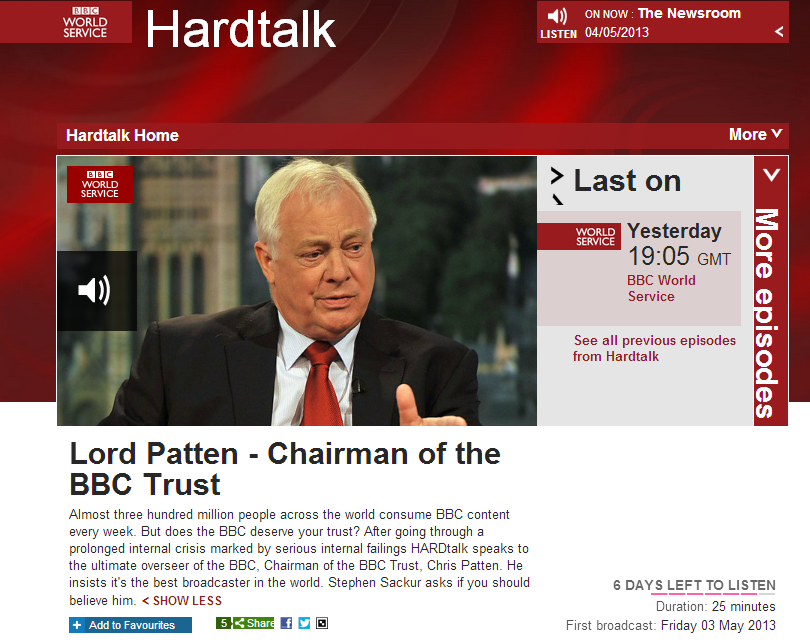
On May 2nd and 3rd 2013 the BBC World Service programme ‘Hardtalk’ – hosted by Stephen Sackur – interviewed the Chairman of the BBC Trust, Chris Patten. 
Hardtalk Patten
The interview can be heard for a limited period of time here, or as a podcast here. A clip from the programme can be viewed here.
The interview is worth listening to in full, but particularly from around 16:06 in the audio version above when Sackur says:
“One other editorial issue that I want to put to you and it concerns James Harding – the new chief of news here at the BBC. He was the editor of Rupert Murdoch’s Times newspaper and when he was at The Times, James Harding said this at a Jewish community centre debate in London in 2011. He said – quote – “I am pro-Israel and I haven’t found it hard because The Times has been pro-Israel for a very long time”. Now, James Harding is now the head of news at the BBC. Are you comfortable for him to pronounce himself pro-Israel as head of news of the BBC?”
Chris Patten replies:
“I’m sure he wouldn’t pronounce himself as pro-Israel or pro any country or part of an argument.”
SS: “But his problem is that he already has.”
CP: “Yeah, but look..”
SS: “I mean he won’t have changed the spots, I don’t suppose…”
CP: “You know perfectly well that I’ve expressed views on the Middle East in books and in articles and you know very well that I used to be in a past life – in a previous incarnation – chairman of the Conservative Party.”
SS: “Sure but..”
CP: “I’ve managed…”
SS: “You’re not head of BBC News and you never have been.”
CP: “No, but I’m chair of the BBC Trust.”
SS: “James Harding is self-declared pro-Israel. Do you have any problem with that? Do you think that it might create problems for you and for the BBC when one considers that perhaps the most contentious issue we all in BBC news and current affairs have to deal with on a daily basis is reporting the Middle East?”
Whether or not the BBC’s record for accurate and impartial reporting from the Middle East will improve under James Harding remains to be seen, but hopefully one practice he will be able to eradicate in the BBC news and current affairs department is that of cherry-picking quotes and then using them to promote a particular agenda. 
Here is a report of Mr Harding’s April 2011 remarks: note Sackur’s apparent addition of the word ‘very’ to the part in his “quote” which says “..because The Times has been pro-Israel for a very long time”. 
“Harding stressed the need for balanced journalism. “We say we’re pro-Israel but we’re also pro the Palestinian state… the question a journalist should always ask himself is are you making the case before opinion is dressed up as reportage?” “
James Harding does not specify what being “pro-Israel” means as far as he is concerned but frankly, these days it often means simply being convinced of Israel’s indisputable right to exist. One does have to wonder therefore what kind of interpretation Stephen Sackur attributes to that phrase. 
The fact that Sackur appears to have no qualms about suggesting publicly that being pro-Israel is or should be “a problem” for a senior BBC employee,  and that if James Harding had “changed his spots” that ‘problem’ would disappear, perhaps reveals more about the institutional culture at the BBC than Stephen Sackur and Chris Patten appear to realise.

City to Celebrate Reunification with Yom Yerushalayim Concerts


Pop, trance, Hasidic, klezmer and more will be mixed with a reverence for the events 46 years ago that opened up a besieged city.

The Municipality of Jerusalem has arranged concerts and activities to celebrate Jerusalem Day, or Yom Yerushalayim, on Tuesday night and Wednesday. The official government holiday celebrates the re-unification of the capital city after 19 year of occupation by the Hashemite Kingdom of Jordan. This includes the Old City which was off-limits to all non-Jordanian Arab citizens.

The annual Yom HaStudent, or Student Day, will take place Tuesday evening, as part of the Jerusalem Day celebrations. Big name Israeli acts will perform for special discount prices for all Israelis with a college or university student ID.


Dubbed "White Night in the Capital," Jerusalem's Student Day will take place in Sacher Park.

Flag dance on Jerusalem Day (archive)

Cousins Ehud Banai and Eviatar Banai will perform. The critically acclaimed singers mix Sephardic music, rock and pop. Ehud Banai's latest CD is "Drops of the Night" from 2011, and prior to that he released Shir Hadash, an album of religious compositions from Rabbi Shlomo Carlebach. His younger cousin Eviatar Banai's latest release was 2009's "Night As The Day Does Shine," which contains songs of a spiritual and Judaic nature.

Israeli trance group Infected Mushroom will perform. The hit group has just released a remix album featuring collaborations with Israeli acts such as Hatikva 6, Asterix and more.

Also performing will be Ethnix, a much loved Israeli band who released a string of hits in the 1990s. The well-established musician Yehudit Ravitz will take the stage, as will the new up-and-coming violin virtuoso Michael Greilsammer. Also performing will Red Band, a satirical act that performs as puppets.

The concert will begin at 9:15 p.m. and is being produced by the Jerusalem Municipality, the Hebrew University Student Union, David Yellin College, Bezalel art college, Hadassah College and others.

The mega concert is one of several special events on Tuesday, Wednesday and Thursday for Yom Yerushalayim, Jerusalem Day.

The national youth conference for the unification of Jerusalem will include a number of events that will take place in the city, from the quaint Nachlaot neighborhood to Armon HaNatziv promenade to the south, and going down through Ammunition Hill, the site of fierce battles in 1967 and on through Mount Scopus and reaching Hinnom Valley. The event will be attended by almost 12,000 youth from around Israel. It will end with a youth assembly at 6:30 p.m. at the Sultan's Pool. Jerusalem Mayor Nir Barkat, and others will speak.

Yeshivat Merkaz HaRav, the Torah academy founded by former Chief Rabbi Avaraham Yitzchak Kook, will hold its annual Yom Yerushalayim celebration on Tuesday. Celebrated veteran klezmer clarinetist Moshe "Musa" Berlin will perform as well as Hasidic pop singer Akiva Margaliot. Participants will conduct their traditional walk from the yeshiva to the Western Wall. Prime Minister Benjamin Netanyahu is scheduled to attend. Other local neighborhood events will take place as well.

Events will continue on Wednesday, the actual date of Jerusalem Day. An official reception with Mayor Nir Barkat at the Tower of David Museum  in the Old City at 3:00 p.m., and the Yakir Yerushalayim award ceremony honoring a worthy citizen of Jerusalem. The city hall's main event is "Jerusalem, for You! Singing Jerusalem on its day of celebration in Safra Square" at 8:30 p.m. on Wednesday. Achinoam Nini and Gil Dor will be the headliners singing Israeli standards accompanied by the Jerusalem Symphony Orchestra.

There will also be free tours, a national memorial ceremony for the fallen soldiers of the Six Day War, and the annual Ethiopian Jewry Memorial Ceremony at Mount Herzl cemetery.
----


Public transportation in the area will continue via alternate routes. For additional information, call Egged at *2800.

On Wednesday, May 8, the main event will be the “Rikudegalim” flag dance and parade, followed by prayers at the Kotel (Western Wall). The following roads will be shut down at some point between 3 p.m. and 9 p.m.: Betzalel, Yitzchak Kariv, Hamelech Shlomo, Shlomtzion Hamalka, Yinnai, Hamelech David, Hativat Hatzanchanim and Haim Bar Lev, which will be closed to from the Sderot Levi intersection to David Hamelech Street.

South-bound traffic on Haim Bar-Lev Street will be redirected to David Remez Street, and north-bound traffic will be redirected to Sderot Eshkol.

Traffic jams are expected on main roads near the city center.

On Thursday, May 9, World War II veterans will march in honor of the anniversary of the defeat of Nazi Germany. The march will take place in the city center beginning at 10 a.m.

From 11 a.m., the following roads will be closed: Hahistadrut, Shammai, Biankini, and Mevo Hamatmid. Hillel Street will be closed from its intersection with King George Street to the Menashe Ben-Yisrael intersection.

At 5 a.m. the Jerusalem Syndrome creative arts festival will begin in the Rehavia neighborhood. Traffic will stop on Keren Kayemet Leyisrael Street from 5 p.m. to 11 p.m.

For further information, Jerusalem residents can contact the municipality at 106.


Arutz 7

Syria Learns: Don’t Cross Israel’s ‘Red Line’


Israel’s air force is reported to have attacked last Thursday a shipment of advanced surface-to-surface missiles from Iran that were believed to be on their way to Hezbollah in Lebanon. Then, early Sunday, according to a Western intelligence source, Israel struck Iranian-supplied missiles headed for Hezbollah again, this time in the vicinity of the Jamraya complex, Syria’s main research center for work on biological and chemical weapons. These attacks followed Israeli airstrikes early this year against a convoy of SA-17 antiaircraft weapons being readied for delivery to Hezbollah. With its strikes, Israel has made clear that it considers the transfer of dangerous weapons to terrorists to be a clear red line that will be enforced with severity if crossed and that there is no room for Syria to test the waters on this issue. The Obama administration, meanwhile, is once again leading from behind on the serious matter of preventing the such weapons from dispersing, while the region rapidly deteriorates.


A spokesman for the Israeli Embassy in Washington said in a statement, “Israel is determined to prevent the transfer of chemical weapons or other game-changing weaponry by the Syrian regime to terrorists, especially to Hezbollah in Lebanon.”

Israel’s intelligence indicates that Hezbollah has already set up several bases in Syria, near known locations housing parts of Assad’s chemical warfare arsenal. Drones may be helping Israel gather intelligence, facilitated by Jordan’s decision to open its air space for the Israeli drone flights en route to Syria.

In addition to the danger of Hezbollah getting access to Syria’s chemical weapons, jihadist opposition forces, led by the al Qaeda-affiliated Al Nusra Front, are now within striking distance of Syria’s largest WMD caches.

Israel understands far better than the United States and its other allies the common threat posed by Islamists on either side of the Syrian civil war. In these circumstances, as Zalman Shoval, a former Israeli ambassador to the United States said, Israel’s options boil down to a choice “between cholera and the plague.”  Thus, Israel’s top priority with regard to Syria is to prevent the transfer of advanced weapons, chemical or otherwise, to Syrian President Bashar al-Assad’s Hezbollah allies and to prevent the seizure of such weapons by jihadists who dominate the opposition fighting to overthrow the regime. “The Israelis are saying, ‘O.K., whichever way the civil war is going, we are going to keep our red lines,’” said Ehud Yaari, an Israel-based fellow of the Washington Institute for Near East Policy.

President Obama has drawn his own red line regarding the Syrian regime’s use of chemical weapons. However, his red line grows blurrier by the day as the U.S. military and intelligence communities acknowledge that we do not know where many of the chemical weapons are located, much less how and by whom they might have been used. “We’ve lost track of lots of this stuff,” one U.S. official told The Daily Beast. “We just don’t know where a lot of it is.”

President Obama is waiting for more conclusive proof of the Syrian government’s use of chemical weapons before deciding on next steps. “We don’t know how they were used, when they were used, who used them, we don’t have a chain of custody that establishes what exactly happened,” he said. Such proof “would cause us to rethink the range of options that are available to us,” he added.

While President Obama’s caution makes sense in deciding whether and under what circumstances to increase U.S. involvement in Syria, he is mistaken in waiting to “mobilize the international community to support what we do.”

The United Nations, to which President Obama has outsourced major portions of his foreign policy, has been paralyzed in dealing with Syria by differences among the permanent members of the Security Council. Russia and China have vetoed several UN Security Council resolutions against the Assad regime.

Lakhdar Brahimi, the U.N.-Arab League envoy for Syria, reportedly plans to resign his post in the coming weeks. Like Kofi Annan before him, who also resigned this post, Brahimi is frustrated by the inability to reach a diplomatic solution to the two year old conflict in Syria. “I am personally, profoundly sorry that my own efforts have produced so little,” he told the Security Council in a closed-door meeting last month. “I apologize to the Syrian people for having, in the end, done so little for them during these past eight months and to you, in this council, for having had only sad news to report to you.”

The United Nations has also been unable to send its expert fact-finding team into Syria to investigate alleged use of chemical weapons. Syria refuses to give its consent for the UN team to conduct the on-site investigation unless the investigation is limited only to the one instance that the Syrian government had reported to the UN, rather than also include in the investigation other instances of alleged use presented by France and the United Kingdom.

H.E. Bashar Ja’afari, Syria’s ambassador to the United Nations, derided the lack of detailed information to back up the French and British allegations, such as blood samples, testimonies of injured persons, medical reports or footage that he said the Syrian government had furnished to the UN Secretariat in support of its allegation. Yet, even if such information were supplied by France and the United Kingdom to the satisfaction of the UN’s technical team as sufficient to warrant an on-site independent investigation of their allegations, Ambassador Ja’afari refused to say whether Syria would consent to allowing such an investigation.

“The Syrian government is still waiting to receive information on these situations,” Ja’afari said. “Then, if the Syrian government and the secretary-general and the Security Council members feel that these allegations are also credible, the Syrian government might — might — examine the possibility of asking for further investigation…then it would be up to us.”

Aside from the UN’s inability to deal with the Syrian crisis, President Obama is searching for an “international consensus” that does not exist beyond the immediate situation with Assad.  It is true that, with the notable exceptions of Russia, China and Iran, there is a broad consensus that Assad should go. The Arab League has gone as far as seating representatives of the Syrian opposition at its recent summit meeting.

Although Russia and China have vetoed several UN Security Council resolutions against the Assad regime, Qatar is moving forward in the UN General Assembly with a proposed resolution welcoming the establishment of the National Coalition of the Syrian Revolution and Opposition Forces and noting “the wide international acknowledgement of the Coalition as the legitimate representative of the Syrian people.” After some minor tinkering, we can expect this resolution to pass overwhelmingly in the General Assembly.

However, the notion that there is any real international consensus on what should come next after Assad is a mirage. Saudi Arabia, Qatar, and Turkey are looking to establish an Islamist state in place of the current regime, not anything resembling the pluralistic secular democracy that the U.S. and its European allies have in mind. The Syrian opposition forces are in fact increasingly dominated by Islamists who hate our guts and would love to get their hands on Assad’s chemical weapons to use against us.

Saudi Arabia, Qatar, and Turkey are providing arms and funding to the opposition. They are using the West’s opposition to the Assad regime and the threat of its use of chemical weapons against its own people to suck us into deeper involvement in toppling Assad. Leading from behind as usual, the Obama administration is now strongly considering arming the opposition and participating in attacks on Syria’s air defenses, missiles and air force, using the chemical weapons threat as a further excuse to buttress a so-called “international consensus” against Assad. France and the United Kingdom are considering supplying arms to the opposition once the European Union arms embargo ends at the end of May. What awaits us in the aftermath of Assad’s overthrow is left for another day to worry about.

The United States should not be guided by a phony “international consensus.” Let the Sunni Arab states and Turkey fight their own battles against Assad and his Shiite backers in Iran and Hezbollah. The carnage is deplorable but, other than providing humanitarian aid, anything we do to intervene in an intra-Muslim battle will backfire. History should be our guide here.

America’s interest is to prevent Syria’s chemical and biological weapons from getting into the hands of terrorists, whether they be Shiite or Sunni jihadists. That should be our only red line. Following the talisman of an “international consensus” is a recipe for disaster.
- -

 comment:  President Obama has drawn his own red line regarding the Syrian regime’s use of chemical weapons. However, his red line grows blurrier by the day as the U.S. military and intelligence communities acknowledge that we do not know where many of the chemical weapons are located, much less how and by whom they might have been used. “We’ve lost track of lots of this stuff,” one U.S. official told The Daily Beast. “We just don’t know where a lot of it is.” 

source

Monday, 6 May 2013

Reality check: The truth behind crossings in Judea and Samaria


The crossings and IDF checkpoints in Judea and Samaria have been the source of much confusion and debate worldwide. Crossings and checkpoints, while both provide important security benefits, are different. Crossings are facilities used by Palestinians to enter from Judea and Samaria into other regions of Israel. Checkpoints, on the other hand, operate during times of heightened security risk to prevent terrorists from executing their plans to harm civilians. The international media have often portrayed these security measures as a way to restrict Palestinians’ freedom of movement and abuse civil rights. They have occasionally been referred to as ‘inhumane’. Despite attention on the region, most facts about the crossings and checkpoints are widely unknown. How many checkpoints are still active? Just how successful are they in preventing terror attacks? What type of security checks occur? Are Palestinians able to move freely? Today, the reality is far from what you may have heard.

How many crossings and checkpoints are there today?
There are some 15 crossings between Judea and Samaria and other parts of Israel. Some are used for the passage of people, others for the passage of goods. In addition to these crossings, 12 checkpoints are placed strategically throughout Israel’s Central Command region, and operate in time of need in light of security considerations.

Checkpoints – Preventing terror, saving lives

Capt. Barak Raz, spokesperson for the Judea and Samaria Division, describes the situation in Judea and Samaria as relatively stable.
“Today, we take into account incidents such as throwing stones, which can be fatal, and we also have the resources to improve road safety. Ten years ago, nobody was keeping track of all this because there was a terror attack every week.”
Last year marked the first year since 1973 in which no Israelis were killed in Judea and Samaria. Compare this to 2002, in which 47 terror attacks left 452 Israeli civilians dead.
Checkpoints have been used as a method to filter out and prevent terror attacks before would-be Palestinian attackers have a chance to enter Israel. As a result of such insidious methods as female suicide bombers hiding explosives under their clothing and the use of ambulances to conceal and transport terrorist weapons, routine checks have been intensified at all types of crossings.
The number of terror attacks has fallen drastically since the construction of the security fence in 2006.
The IDF has withdrawn the majority of its checkpoints in Judea and Samaria in a step towards beginning a positive cycle, Capt. Raz explains:
“The Palestinians have realized that the path of terror led them nowhere. We can explain this relative calm in three ways: the reduction of military presence during routine security tasks, an effective counter-terrorism strategy, and a clear economic incentive for Palestinians to maintain the calm. By reducing the number of checkpoints, we can provide much more freedom of movement, therefore improving the economic conditions and ultimately strengthening the security situation.”

From 40 to 12 checkpoints

The number of checkpoints in the Central Command went from 40 in July 2008 to just 12 in October 2012. Furthermore, these checkpoints are only used some of the time and the frequency of checks is dependent on the security threat at the time.
Barak Raz explains that the relative calm in the region has been brought about by the success of security measures which routinely prevent attempted attacks.
“Despite the calm, the willingness to carry out terror attacks is still present, but we are able to counter them better. This may seem paradoxical since there are fewer checkpoints. However, we use the 12 points as soon as we receive the warning of an imminent threat. Every vehicle at each location is then checked. In approximately thirty minutes, we stop the suspects and the situation returns to normal.”

Freedom of Movement

Separate roads are used to enter Palestinian and Israeli communities. It is important to remember that Israeli vehicles are prohibited from entering roads leading to Area “A” (the area under full civil and security control of the Palestinian Authority) just as Palestinian vehicles are not permitted to leave Judea and Samaria in order to enter into Israel.
Sign prohibiting entry to Israeli vehicles into Area “A”.

Sign prohibiting entry to Israeli vehicles into Area “A”.
The main roads linking Palestinian cities, including Route 60, are freely accessible and free of security controls. A Palestinian civilian can travel from Jenin to Bethlehem without encountering a single military checkpoint.
Some people who have traveled the roads in Judea and Samaria and seen yellow barriers on the side of the road have mistaken them for checkpoints. Capt. Raz explains the surprising truth behind these barriers: they are used to save Palestinian lives.
“Today we face more and more problems with road safety. Many residents of Palestinian villages try to take shortcuts and enter onto main roadsfrom small dirt roads beside of their homes,” Capt. Raz explains. “This is dangerous for both Israeli and Palestinian drivers. Road accidents have become the leading cause of death among Palestinians in Judea and Samaria. To counter this, we installed the yellow barriers to restrict access [to the main roads] to other vehicles.”

Crossings: 9.4 million entries in 2012

Crossings are the main points of entry between Judea and Samaria and other parts of Israel. Ceratin crossings – such as Bituniya – are intended for the inspection and transfer of goods.
There are also crossings intended for the passage of Palestinian civilians such as those at Kalandia and Hashmonaim. These crossings have received much criticism for alleged violations of human rights. Is this criticism justified?
Who is allowed to enter and who is not?
Every Palestinian wishing to visit relatives or work inside Israel must contact the office of the Coordinator of Government Activities in the Territories (COGAT).
“Our role is to ensure the safety of every Palestinian civilian, that he or she has freedom of movement and economic access,” says Maj. Amos Zuaretz, Head of crossings in COGAT.
Obtaining an entry permit is a simple two-step process. Palestinians must first obtain a biometric card at any of the 31 COGAT offices in Judea and Samaria. The applicant receives the card – designed to ease waiting times at crossings – five minutes after filling out the form.
Next, one wishing to obtain permission to cross must apply to a Palestinian Authority liaison officer who makes contact with the Israeli authorities. The vast majority of applications are processed and approved within 24 hours.
There are 74 types of authorization, which vary according to the type of activity and permit duration. The two most requested permits are humanitarian permits and commercial permits.
What is the procedure at crossings once authorization is approved?
This is actually quite straightforward and would be familiar to anyone who has entered any airport in the world. Each person must first pass through a metal detector and pass their bags through a scanner, just as every Israeli citizen or tourist must at any of Israel’s train stations. At this stage, there is no physical contact with soldiers. Most Palestinians already know the procedure. Soldiers oversee everything from an isolated control room and communicate via intercom.
Left: Hashmonaim Crossing entrance. Right: Tel Aviv Central Train Station entrance.

Left: Hashmonaim Crossing entrance. Right: Tel Aviv Central Train Station entrance.
After that, each person’s card is reviewed by a COGAT official who takes a digital fingerprint scan. Lastly, a soldier verifies that the permit is in order and authorizes entry.
“In 2012, there were 9.4 million entries at all crossings combined. This figure has been rising steadily since 2010,” says Maj. Zuaretz.
Identity and permit verification at the Hashmonaim Crossing.
When that person returns home later on, he/she simply passes his/her magnetic card through a scanner and walks through a turnstile.
If all goes well, there is no actual contact between Palestinians and Israeli soldiers. The whole procedure takes five minutes once started. However, some crossings are widely used and lines can be long. An average of 15 thousand people use the Kalandia crossing each day and the majority of those people cross in the morning. In comparison, about 35 thousand individuals go through Ben Gurion International Airport every day. It is not uncommon to see relatively long lines like those at crossings in international airports.
Left: Hashmonaim Crossing exit. Right: Tel Aviv Central Train Station.

475 Attempts to Smuggle Weapons

The various crossings and checkpoints have proven to be effective barriers against weapons smuggling and the crossing of illegal workers. In 2012, the Military Police Corps recorded a total of 475 attempts to smuggle weapons into Israel and 1,147 illegal attempts to enter Israel with forged ID cards. The Military Police and officers from the Ministry of Defense responsible for crossings have thwarted many attempted attacks and arrested dozens of people in possession of explosives. Most recently, on April 30, 2013, a 31-year-old Israeli civilian was stabbed to death at Tapuah Junction – the intersection of routes 60 and 505.
Although the situation is better than in the past, the ongoing presence of these checkpoints remains necessary. The proof is in the numbers.
Two examples of explosives and weapons seized at crossings in 2011.


http://www.idfblog.com/


Expert: 'Israel Will Only Interfere if Security Threatened'


Tel-Aviv University professor speaks to Arutz Sheva following recent reports of Israeli attacks outside Damascus.


Professor Eyal Zisser, Dean of the Faculty of Humanities at Tel-Aviv University, spoke in an exclusive interview with Arutz Sheva following the recent reports of Israeli attacks on military targets on the outskirts of Damascus.

There is “nothing new” in such attacks, said Zisser, adding that this is not the first time Israel has attacked military warehouses and other military installations in an effort to prevent advanced weapons from falling into the hands of Hizbullah.

Zisser, who is also a senior research fellow at the Moshe Dayan Center for Middle Eastern and African Studies, said that while the Jewish state will not interfere in the Syrian civil war it will exert efforts to ensure that such weapons do not fall into the wrong hands.

He said that he does not expect a Syrian response to the Israeli assault, as it is in the interest of Syrian President Bashar al-Assad to fight his “real enemies,” namely the Syrian rebels who seek to oust him from power.

“He cannot allow himself to engage in a new front,” he said, adding, however, if such assaults continue on an ongoing basis he will be forced to rethink his position.

Meanwhile Syria’s Deputy Foreign Minister Faisal Mekdad warned Sunday that the airstrikes on facilities near Damascus constituted an Israeli “declaration of war.”

VIDEO:  Israel's Message: We Won't Interfere - Untill You Endanger Us  - click here


IDF Closes Airspace over Haifa

SDEROT: ISRAEL

 Contributed by CAMERA Intern Rebecca Pritzker:

15

: The siren sounds.
14
: Paralyzing panic. Frozen fingertips and suspended motion.
13
: Mayhem.
12
: Chaos.
11
: Pandemonium.
10
: Running. Everyone is running.
9
: Children scurrying. Parents herding and carrying them.
8
: Where is the nearest shelter?
7
: Will I make it?
6
: Will everyone make it?
5
: Make space. Brace yourselves.
4
: Where is my family?
3
: Hyperventilate. It’s impossible to breathe.
2
: Some children sing in unison.
1
: Eyes closed. Shut tightly. Pray.
0
: Explosions. Cries of pain and worry. Ambulance sirens sound.
No more shock. Just fear. Perpetual fear.
Not once, not twice, but continuously. This is the life of a resident of Sderot, Israel.
When Hamas, the terrorist organization that governs Gaza, which is only about one kilometer from Sderot, orders rockets to be fired into the small city, residents have only 15 seconds to reach a shelter.
Whether they are at the grocery store, the elementary school, the park, or anywhere else that life may take them, residents of Sderot must be constantly vigilant. They live their lives knowing that at any moment, a siren could sound, indicating that there are 15 seconds before a rocket lands nearby.
map
In her op-ed, “Iran in Israel’s Backyard,” Ellie Rudee poignantly depicts some of the horrifying circumstances under which residents of Sderot must live: the ominous threat of rockets is constant.
Rudee references avideo about Sderot kindergartners and their teachers hastening to the safety of a shelter after a siren sounds to warn them about incoming rockets.
That was 2007. Even back then, though, the kindergartners had grown somewhat accustomed to the onslaught of rockets. They automatically ran to the shelter when the siren sounded, and once there, they shouted, counted backwards, and sang, as if they had done so dozens of times before.
housedirecthit-640x480
The then five and six-year-olds are now pre-teens. The threat of rocket fire in Sderot, however, has remained constant. And the combined terror and peril affects every single resident of the city.
If you watch the news, listen to the radio, or read the newspaper today, however, it is unlikely you will learn anything about Sderot and the continual terror its citizens face. Rockets land there on an almost daily basis, yet most do not know about this small city.
But it is time that they did..
http://www.cameraoncampus.org/blog/