Showing posts with label Media Bias. Show all posts

Wednesday, 12 February 2014

BBC continues to ignore Gaza Strip missile fire at Israeli civilians


Since the beginning of February, multiple missile attacks on civilian communities in southern Israel have been carried out by terrorist groups operating in the Gaza Strip.
On the morning of February 4th, as children were on their way to school just after 7 a.m., a missile landed in the Eshkol region.
On the afternoon of February 6th an attack was launched on the Ashkelon area. On the same evening another missile landed in the Ashkelon region and later that night at around 11 p.m. an incoming missile hit the Eshkol district.
On February 8th a missile hit the Sdot Negev area.
On the afternoon of February 10th a missile landed in the Hof Ashkelon area and later that night another missile hit the same region. The IDF responded by targeting terror infrastructure in the Gaza Strip.
None of the above incidents was reported by the BBC. 
SONY DSC
Deir el Balah area of central Gaza Strip as seen from the Eshkol region

On the morning of February 9th the IDF targeted Abdallah Kharti – a member of the Popular Resistance Committees and also a Global Jihad operative.  
“According to intelligence data, Kharti played a central role in setting up the terrorist infrastructure in Sinai, which has been firing rockets at Eilat sporadically in recent months, including the most recent rocket attack, launched on January 31, and intercepted by the Iron Dome anti-rocket battery.
In Gaza, Kharti is a member of the Popular Resistance Committees, but he apparently wears more than one hat. In Sinai, he is affiliated with the al-Qaida- inspired Ansar Beit Al-Maqdes group, which has been targeting both Israel and Egyptian security forces. [..]
The attempted strike is a reminder that Gaza is a base not only for Hamas and Islamic Jihad terrorism but also for a growing al-Qaida-affiliated presence as well. According to Israeli intelligence estimates, there are hundreds of Salafi-jihadis in Gaza armed with rockets, and many move between Sinai in Gaza regularly.
Hamas has attempted to persuade these factions to refrain from endangering it by provoking an Israeli response against Gaza’s regime, but it has also signaled to the groups that they are otherwise free to attack Israel as they please.”
Notably, the BBC did not report on that incident either. 
As we see, the BBC continues its habit of selective reporting of security incidents on Israel’s southern borders, thus denying audiences information and context vital to their understanding of the region in general and specific Israeli responses to terrorist threats.
BBC Watch

Thursday, 6 February 2014

Telegraph has 3 articles on settlers’ Kerry spoof; ignores Palestinian incitement


If you go to the Israel page of The Telegraph, you'll find three separate stories (and over 1100 words of text) devoted to one short satire produced by the Yesha Council (umbrella organization of councils of 'settlements' in Judea and Samaria) that is critical of US Secretary of State John Kerry.
telegraph
Two of the stories were filed by Robert Tait (the paper's Jerusalem correspondent) within three hours of each other. One characterized the poke at Kerry as "a deliberately disrespectful spoof depicting America’s top diplomat", while the other editorialized that the clip "undermin[es] a plea from the White House for Israeli politicians to desist from personal attacks on the US secretary of state", ignoring the fact that the the Yesha Council is a settler's advocacy group, not a political party.
Here's the video:
While one can reasonably find the video objectionable, it's curious that Tait would frame one short (and relatively benign) YouTube clip as somehow injurious to peace efforts while, like most of this fellow British journalists, failing to devote serious coverage to genuine incitement to violence by high level Palestinian politicians.  Indeed, just a few weeks ago, the Telegraph failed to even note a disturbing clip of PA President Abbas applauding a PA Minister of Religious Affairs after he called for jihad in Jerusalem. 
Videos such as these, attesting to dangerous incitement to violence by Palestinian officials and explicit antisemitism in the state-controlled PA media, are ubiquitous and easily accessible for journalists genuinely concerned with actions on either side which undermine the Israeli-Palestinian peace process.  CIF Watch

Sunday, 2 February 2014

Kerry slammed by right for 'encouraging' Israel boycott

US Secretary of State says status-quo between Israelis, Palestinians is unsustainable, warns of de-legitimization of Israel.

US Secretary of State John Kerry at the Munich Security Conference in Germany Photo: REUTERS

Economy Minister Naftali Bennett slammed US Secretary of State John Kerry Saturday night, saying he should be supporting Israel rather than encouraging boycotts against it.

Bennett’s post – coming weeks after Defense Minister Moshe Ya’alon was quoted as calling Kerry “obsessed” and “messianic” about the Israeli- Palestinian conflict – was in response to comments that the secretary of state made Saturday at the Munich Security Conference.“Let’s make clear to all those giving advice: A nation has not been born – including us – that will give up its land because of economic threats,” Bennett said in a Facebook post. “The Jewish people is stronger than the threats against it.”

“Today’s status quo, absolutely to a certainty, I promise you 100 percent, cannot be maintained,” Kerry said of the Israeli-Palestinian conflict. “It is not sustainable. It is illusionary.

You see for Israel there is an increasing delegitimization campaign that has been building up. People are very sensitive to it, there is talk of boycott and other kinds of things. Are we all going to be better with all of that?” Kerry’s comments were similar to ones he made during a television interview during one of his visits in November, though this time he did not warn, as he did then, of the outbreak of a third intifada.

Bennett, on his Facebook page, said that only security would bring economic stability, not a terror state next to Ben-Gurion Airport.

“We expect our friends in the world to stand by our side against anti-Semitic boycott efforts against Israel, and not be their trumpet,” he said.

“Either way, we knew in the past, and will know today, how to remain strong.”

Kerry, during his comments, made an allusion to Ya’alon’s comments last month.

“I’m a little surprised at some of the articles that tend to write about an obsession or fanatical effort to try to achieve this,” he said. “We are just working hard, because the consequences of failure are unacceptable.”

He said he remained hopeful that the Obama administration’s effort to broker a peace deal between Israelis and Palestinians could succeed.

“I believe in the possibility or I wouldn’t pursue this,” he said. “I don’t think we’re being quixotic.

Ya’alon was also in Munich for the conference, and met with US Defense Secretary Chuck Hagel.

“The US is Israel’s best friend, and our appreciation is great,” Ya’alon said. “We have common values, interests, and deep ties that overcome disagreements, when they appear.”

The defense minister, who has expressed deep skepticism about chances of success in the Kerry-led negotiations, said that “despite the gaps, we support a continuation of negotiations with the Palestinians.”

Last week, Bennett lashed out at Prime Minister Binyamin Netanyahu for suggesting that some settlers would live in a Palestinian state following a peace deal, and while the criticism nearly caused a coalition crisis, it found support on the Right. Likewise, Bennett was not alone when he turned his sights on Kerry for mentioning a threat of boycotts.

“The only fantasies are the slogans of peace Kerry is trying to sell to Israel,” Construction and Housing Minister Uri Ariel (Bayit Yehudi) said. “These slogans are trying to cover up an existential threat on the State of Israel. The Palestinians do not believe their luck at receiving such a ‘fair’ mediator.”

Deputy Defense Minister Danny Danon said that while Israel respected Kerry, there could not be negotiations “with a gun to our heads.”

“Friends don’t make ultimatums about the security of the State of Israel,” Danon stated. “We will make decisions that protect our interests. If we would make decisions according to predictions of boycotts, we wouldn’t be here today. We’ve seen in the past that terror arrives in any place the IDF doesn’t have a presence.”

And Deputy Transportation Minister Tzipi Hotovely (Likud Beytenu) added, “Kerry’s unprecedented threats of a boycott are an attempt to terrorize Israel and force it into an agreement that opposes the government’s position. Such an agreement would endanger Israel more than any economic boycott.”

Meanwhile, the fog thickened over the weekend regarding what exactly is and is not being discussed between the sides and the US regarding the document Kerry is expected to present that will form a basis for continued negotiations. Israel and the Palestinian negotiators have not met for a number of weeks, and all the talks now are between the sides separately with the Americans.

The State Department on Friday issued a clarification regarding an off-record telephone briefing that US envoy Martin Indyk gave Jewish leaders on Thursday, saying the description Indyk gave of a possible US-drafted framework was not final.

“During an off-the-record briefing with Jewish leaders, Ambassador Indyk reiterated the well-known United States position in support of 1967 borders plus swaps as a part of a broad discussion on ideas being discussed for a framework,” State Department spokeswoman Jen Psaki said in a statement. “But given this is an ongoing process and these decisions have not yet been made, at no point did Ambassador Indyk make a prediction of the final contents of a framework.”

In the call, Indyk detailed security arrangements on the Jordan-West Bank border, the terms for mutual recognition of Israel as the nation state of the Jews and Palestine as the nation state of the Palestinians, land swaps, and the settlement of the refugee question, including, for the first time in a formal document, compensation for Jewish refugees from Arab lands.

“I hope that Jewish refugees, who suffered greatly under physical persecution, will get reparations,” Knesset Caucus for Jewish Refugees from Arab Countries chairman MK Shimon Ohayon (Likud Beytenu) said. “This is an opportunity to learn and recognize the story of their exit and expulsion.”

According to Ohayon, the progress on this front is a result of the Foreign Ministry putting Jewish refugees from Arab countries on its agenda.

State Department officials said that there was no expectation that the framework would be completed in “weeks,” although Indyk had said it was his hope that it would.

Indyk said in the call that there would be “no surprises” for the Israeli and Palestinian leaders, and that Netanyahu and Palestinian Authority President Mahmoud Abbas would be expected to accept the agreement, with reservations, as the basis of continued negotiations.

Making it a US-drafted framework permitted the leaders to distance themselves from politically sensitive issues, Indyk said. “There may be things we need to say because they can’t say them yet,” he said, according to the notes of one participant.

On some sensitive issues – particularly the status of Jerusalem – the framework would be vague, Indyk said.

Regarding Indyk’s reference during the call to the expectation that land swaps would allow 75-80% of settlers to stay in Israel, the officials said that that arose not from the current talks but from previous estimates during the 20-year-long peace process. Indyk, during the call, said his impression was that Abbas was not averse to allowing settlers who want to remain to be citizens of the Palestinian state.

Council of Jewish Communities in Judea and Samaria head Dani Dayan disputed Indyk’s claim on Friday morning, saying Indyk was including east Jerusalem in the 80% of settlers that would stay under Israeli rule.

“Martin Indyk’s vision for the Jews of Judea and Samaria is extremely misleading,” Dayan said in a statement.

“When Indyk speaks of 80% of our communities remaining under Israeli rule, he is including eastern Jerusalem. Which would mean the forceful uprooting and eviction of up to 150,000 Israelis from their homes, which is morally repugnant and unacceptable to all,” he added.

In a related development, representatives of the Quartet – the US, EU, UN and Russia – met on the sidelines of the Munich conference and issued strong support for Kerry’s efforts. They reiterated, in a reference to the EU’s promise of upgraded relations with both sides if a deal is reached, that there would be unprecedented support for both Israel and the Palestinians if an accord was signed.

Jeruselam post

‘CiF’ reveals anti-SodaStream agenda: Harming the livelihood of 500 Palestinians:: Plus Video


The Guardian’s first few days of coverage of the debate over Scarlett Johansson’s role as global ambassador for SodaStream, and her subsequent decision to step down as Oxfam ambassador, was, by their standards, relatively fair.  However, yesterday, true to form, they published a commentary at ‘Comment is Free’ supporting the boycott and criticizing Johansson’s involvement with the Israeli based company.
Here is the most relevant passage in a commentary by Vijay Prashad titled ‘Scarlett Johansson is right; the face of SodaStream doesn’t fit with Oxfam‘, Jan. 30:
Johansson’s new job posed a serious problem for Oxfam. The charity has over the years taken a strong position against Israel’s illegal settlement construction at the same time as it has worked to deliver much-needed goods and services to the encaged population in the occupied Palestinian territories. In a powerful briefing paper from 2012, Oxfam called on Israel to “immediately halt the construction of all illegal settlements” and end “policies and practices that are illegal under international law and harm the livelihood of Palestinian civilians”.
Leaving his agitprop aside, Prashad’s suggestion that the SodaStream plant in Mishor Adumim would “harm the livelihood of Palestinian civilians” is the opposite of the truth. Indeed, if BDS activists got their wish the plant would close, ending employment – which includes above par wages and generous benefits – for over 500 Palestinians (and hundreds of Israelis) currently employed there.
So, it appears as if BDS activists like Prashad are the ones who threaten to “harm the livelihood of Palestinian civilians”
So fanatical is the BDS cause that Israeli-Palestinian co-existence and laying the seeds of economic development for the future Palestinian state necessarily take a back seat to their malign obsession with Israel.
Of course, peace is likely the furthest thing from Prashad’s mind, as he is on the Advisory Board of the US Campaign for the Academic and Cultural Boycott of Israel, an organization which characterizes Zionism as a form of ethnic or racial supremacy, and opposes the existence of the Jewish state within any borders.  
(Curiously, the Guardian failed to note Prashad’s affiliation with the pro-BDS group, an extremely misleading omission in the context of his explicit support for boycotting SodaStream.)
As Prashad’s commentary again indicates, anti-Zionists are not only hostile to Israeli communities across the green line, but fundamentally oppose the Jewish right to self-determination, the concept of two-states for two peoples and all efforts to promote peace and co-existence.
Remind us again why such ideological extremists are continually framed as ‘liberal’ activists by the Guardian and the mainstream 


click on link for video.....

Jason Kenney thanks the nutters at Oxfam, he's buying a Soda Stream


related -

"Pro-Palestinians" - Versus Real Palestinians


Tuesday, 28 January 2014

Hamas in Jenin: Pictures the BBC will NOT show.


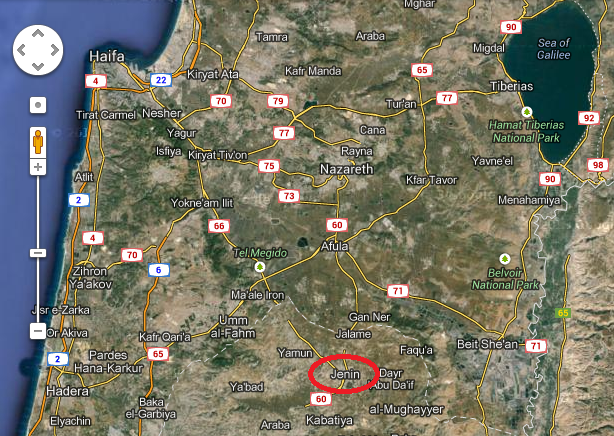
On December 18th 2013 the BBC News website published an article pertaining to a counter-terrorism operation in Jenin during which Nafe a-Sa’adi was killed when Israeli soldiers trying to make an arrest were attacked by a mob.
At the time we noted here that the BBC chose to place the term counter-terrorism in scare quotes both in the sub-heading and in the body of the report, suggesting to audiences that there was room for scepticism with regard to the nature and definition of the operation.
“A Palestinian man is killed and at least four wounded after Israeli troops launch a “counter terrorism” operation in the West Bank.”
“Israel said its forces opened fire after being attacked during “counter terrorism activity” in the camp.”
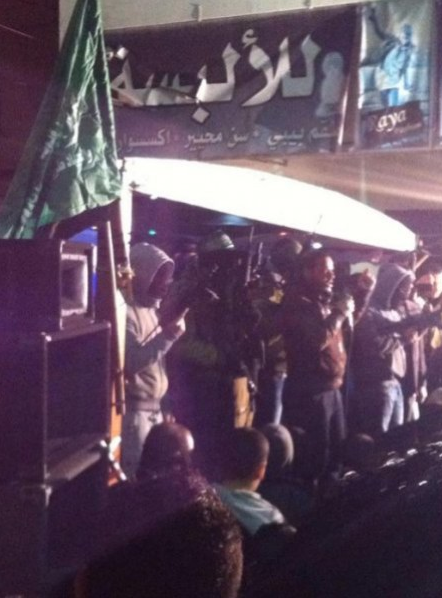
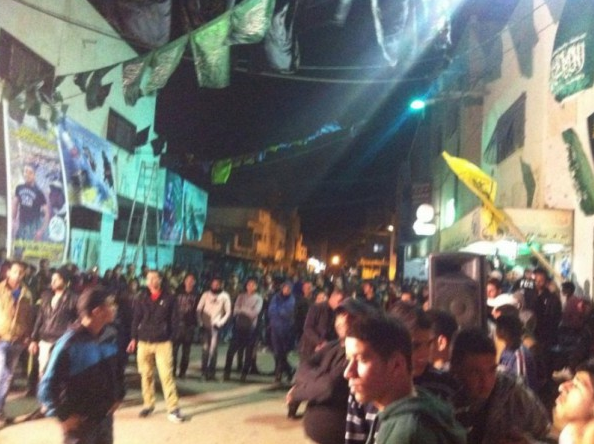
On January 26th a memorial event for Sa’adi was held in the Jenin refugee camp, with armed members of Hamas’ al Qassam brigades making a rare centre-stage appearance. Photographs from the event can be seen here and here.
Jenin 26 1 14
Jenin b 26 1 14
BBC audiences are of course highly unlikely to be shown such photographs or to be informed of the significance of publicJenin appearances by armed members of a terrorist organisation in a Palestinian Authority controlled region which lies within walking distance of the nearest Israeli communities.  
Instead, their ability to form an understanding of the security issues facing Israel – and hence also of any preventative actions taken – is shaped by an editorial policy based upon the patchy reporting of selected incidents (more often than not those involving fatalities) in isolation from the picture as a whole, the omission of any reporting on numerous other incidents and the promotion of a narrative which plays down the existence and scale of terrorism even through choice of language and punctuation.
BBC Watch.org

Tuesday, 17 December 2013

Harriet Sherwood adaciously suggests that Palestinians have abandoned terror

All Harriet needs for Christmas is a new brain.
One of the many articles published in early November by the Guardian about the Swiss report on the death of Yasser Arafat concluding that the late Palestinian leader was likely poisoned – a theory contradicted by a subsequent  French report - was penned by Harriet Sherwood, and titled ‘Arafat polonium find likely to be another hurdle for peace talks‘.  
Sherwood’s story strangely argued that the Swiss findings were “likely to worsen the already corrosive atmosphere of the faltering peace negotiations and fuel popular demands that the Palestinian leadership walk out”, and, we noticed after reviewing the article again, this even more curious conclusion about Palestinians.
Arafat was a man who divided the world: revered by Palestinians and their supporters, reviled by Israel and its allies. Nine years after his death, a portrait of him still hangs in most Palestinian homes. Nonetheless, the Palestinian people have inevitably moved on. Acts of violence, espoused by Arafat, are rare in the West Bank, and rocket fire from Gaza has dropped; instead, the Palestinian leadership has invested its hopes in diplomacy and negotiations.

The broad suggestion that Palestinians have largely abandoned Arafat’s ‘strategy’ of terrorism represents an almost staggering distortion based on empirical data on the quantity of terror attackssince his death.  (In 2005 alone, 2,990 Palestinian terror attacks were recorded.)  Further, though such attacks have decreased overall in comparison to the height of the 2nd Intifada, this reduction is largely attributed to the construction of Israel’s security fence and more effective counter-terror measures, not changing Palestinian attitudes towards terror.
Additionally, Sherwood’s claim that “acts of violence…are rare in the West Bank” is also simply not true.  As BBC Watch’s Hadar Sela recently reported, “statistics provided by the ISA [Israel Security Agency] for the months July to November 2013 shows that the number of terror attacks taking place in Judea and Samaria [the West Bank] and Jerusalem since the renewal of direct negotiations between Israel and the PLO on July 29th has more than doubled”. 

Terror incidents since July, 2013.

Sherwood’s additional claim that “rocket fire from Gaza has dropped” is also extremely misleading.  As the graph below on rocket attacks from Gaza demonstrates, rocket attacks from Gaza increaseddramatically since Arafat’s death in 2004 (and Hamas’s control of the Strip in 2006).   While rocket attacks did decrease following the Gaza war (Cast Lead) in 2008-09, they increased again each year after the conflict until Israel launched an eight-day war in November 2012 (Pillar of Defense).

graph
Beyond the statistical evidence contradicting Sherwood’s specific claims, it’s hard to understand how anyone covering the region as long as she has could possibly come to the conclusion that Palestinians have in any way abandoned terrorism.  In addition to the ubiquitous examples of the Palestinian glorification of terrorists, a comprehensive report on Arab public opinion by Pew Global in September demonstrated that “support for suicide bombing and other violence aimed at civilian targets is most widespread in the Palestinian territories“.  A staggering 62% of [Palestinian] Muslims, per this poll, believe that such attacks “are often or sometimes justified in order to defend Islam from its enemies”.

pal terrorism support
Though we’ve, on occasion, noted reports by Sherwood which suggest a modest amount of improvement in her coverage of the region, the amount of disinformation conveyed in those two sentences we cited (on Palestinian attitudes towards terror) again reminds us that her pro-Palestinian sympathies will trump a sincere commitment to accuracy almost every time.

Thursday, 5 December 2013

BBC amplifies Hizballah propaganda yet again


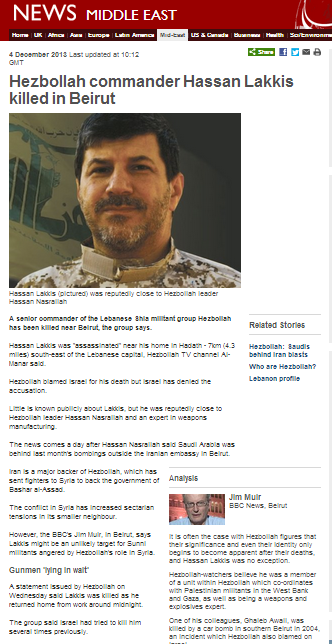
Late on the night of Tuesday December 3rd a senior Hizballah operative named Hassan Lakkis (also Laqis) was allegedly shot outside his home in Beirut and later died of his wounds. By Wednesday lunchtime local time, a Lebanese Sunni group had taken responsibility for the incident. 
“The Free Sunnis of Baalbek Battalion officially claims the heroic jihadist operation of assassinating the leading member in the party of the devil [Hezbollah] Hassan Houlo al-Laqis in [Hezbollah’s] home ground,” the group wrote on twitter.
“The jihadist operation was implemented by free Sunni lions from Lebanon,” another tweet wrote.
Now Lebanon tweet
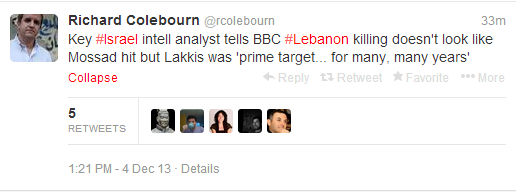
The BBC News website’s coverage of the story began on Wednesday morning and has since undergoneextensive changes. From the first version of the article, however, one of its dominant themes was the repetition of unfounded Hizballah accusations concerning Israel’s involvement in the attack, despite the BBC clearly being aware of the absence of any evidence to support them. 
Colebourn Lakis tweet
Lakis art 1
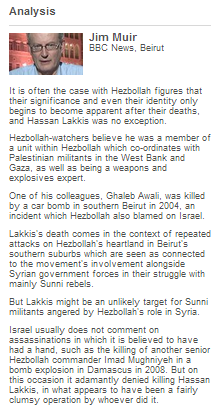
The article as it currently stands at the time of writing, together with the side box of analysis by the BBC’s Beirut correspondent Jim Muir, totals 666 words – with the words ‘Israel’ and ‘Israeli’ being used nine times. Muir sidebox Lakis
In the body of the article readers are told that:
“Hezbollah blamed Israel for his death but Israel has denied the accusation. […]
“The group [Hizballah] said Israel had tried to kill him several times previously.” […]
“Israel denied any involvement in the death.”
“These automatic accusations are an innate reflex with Hezbollah,” Israeli foreign ministry spokesman Yigal Palmor said. “They don’t need evidence, they don’t need facts. They just blame anything on Israel.” […]
“Hezbollah fought a destructive 34-day war with Israel in 2006. The group said that one of Lakkis’s sons had been killed in that conflict.”
In his sidebox of analysis Muir writes:
“One of his colleagues, Ghaleb Awali, was killed by a car bomb in southern Beirut in 2004, an incident which Hezbollah also blamed on Israel.” […]
“Israel usually does not comment on assassinations in which it is believed to have had a hand, such as the killing of another senior Hezbollah commander Imad Mughniyeh in a bomb explosion in Damascus in 2008. But on this occasion it adamantly denied killing Hassan Lakkis, in what appears to have been a fairly clumsy operation by whoever did it.”
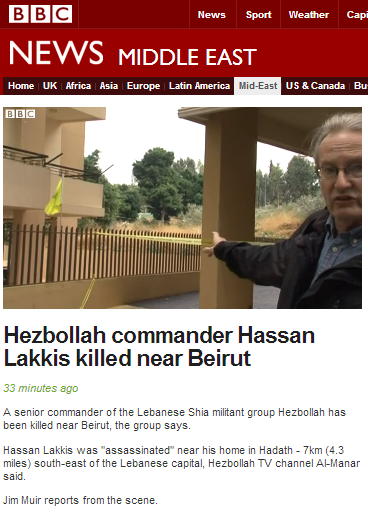
In a filmed report broadcast on BBC television news and also placed on the BBC News website, Muir repeated the Hizballah line.
“But of course Hizballah itself has been very quick to blame Israel for this killing – something the Israelis have denied. Now normally, if they have had a hand in something, or it’s believed they have, they keep quiet – they say absolutely nothing.”
Muir filmed Lakkis
So busy is the BBC repeating and promoting the baseless propaganda of a terrorist organization, that exploration of the possibility that the assassination might have been carried out by any actor which is not Israel is reduced to one vague sentence in Muir’s analysis, which was repeated in the body of the main article’s earlier versions – including the decidedly curious use of the term “unlikely target”.
“But Lakkis might be an unlikely target for Sunni militants angered by Hezbollah’s role in Syria.”
Likewise, the terrorist organisation’s role in the Syrian civil war is also downplayed, both in the article itself and in Muir’s sidebox.
“Iran is a major backer of Hezbollah, which has sent fighters to Syria to back the government of Bashar al-Assad.”
“Lakkis’s death comes in the context of repeated attacks on Hezbollah’s heartland in Beirut’s southern suburbs which are seen as connected to the movement’s involvement alongside Syrian government forces in their struggle with mainly Sunni rebels.”
Notably, the article fails to make clear to readers Hizballah’s designation as a terrorist organization which is operational worldwide, describing it thus:
“Hezbollah – or the Party of God – is a powerful political and military organisation in Lebanon made up mainly of Shia Muslims.
It emerged with financial backing from Iran in the early 1980s and began a struggle to drive Israeli troops from Lebanon.”
As Michael Totten has noted:
“And yet Hezbollah is still often described, by itself and by its Western apologists, as an indigenous Lebanese “resistance” movement in a twilight struggle against the Jewish state. It is, in fact, a multinational terror operation with Iran as its funder and controller.”
The BBC article also states that:
“Little is known publicly about Lakkis, but he was reputedly close to Hezbollah leader Hassan Nasrallah and an expert in weapons manufacturing.”
As is documented in Matthew Levitt’s recently published book, Lakkis was previously also responsible for Hizballah’s procurement of arms and military equipment.
“In 2001, Mohammad Dbouk was indicted in U.S. federal court under Operation Smokescreen. According to U.S. investigators, Dbouk is an Iranian-trained Hezbollah operative and “an intelligence specialist and propagandist [who] was dispatched to Canada by Hezbollah for the express purpose of obtaining surveillance equipment.” According to information collected by the Canadian Security Intelligence Service (CSIS) during its investigation into Mohammad Dbouk’s activities in Canada, first in Montreal and then in Vancouver, Dbouk was acting under the direction of Hezbollah’s then chief of procurement, the aforementioned Haj Hassan Hilu Laqis, who was based in Lebanon.” [emphasis added]
Just a couple of weeks ago the BBC was amplifying Iranian propaganda on the subject of the terror attack on the Iranian embassy in Beirut – see here and here.  In this article (as well as in a separate one) it now adds Hizballah propaganda to its cocktail of unfounded accusations surrounding that incident.
“The news comes a day after Hassan Nasrallah said Saudi Arabia was behind last month’s bombings outside the Iranian embassy in Beirut.”
The BBC clearly has a problem knowing how to relate to the streams of all too predictable propaganda regularly produced by regimes and terrorist organisations in the Middle East. Its current practice of uncritical repetition and amplification of baseless rumour, conspiracy theories and propaganda is clearly incompatible with its obligation to “build a global understanding of international issues” and its self-declared aspiration to “remain the standard-setter for international journalism”.
The BBC’s remit is to help audiences look beyond the propaganda and rhetoric they can just as easily view on websites and television stations run by Hizballah or the Iranian and Syrian regimes rather than giving it inappropriate credence through uncritical repetition and amplification on its own website and television news
---------