Showing posts with label Hezbollah. Show all posts

Wednesday, 26 February 2014

Israeli official confirms: IAF hit missile convoy entering Lebanon

Anonymous Israeli official tells TIME that IAF jets struck a missile transport destined for Hezbollah.


Israeli warplanes struck a convoy transporting surface-to-surface missiles from Syria into Lebanon on Monday in an attempt to prevent Hezbollah from obtaining certain weapons, an anonymous Israeli security official reportedly told TIME Magazine on Tuesday.

On Monday night, Lebanese media reported that IAF jets had hit a Hezbollah target near the Lebanon-Syria border.

The unnamed senior security official hinted to TIME that the Lebanese, Shi'ite terrorist organization was capable of carrying warheads heavier and more dangerous than Hezbollah'sreported stockpile currently pointed toward Israel.Thus far, the Israeli army has refused to comment on the reports.

Prime Minister Binyamin Netanyahu has failed to confirm or deny reports that Israel struck targets on the Syria-Lebanon border late Monday night, cryptically stating that Israel does everything in its power to defend its citizens.

While some Lebanese reports suggested the attack was carried out against a Hezbollah missile base, others stated that the target of the bombing sorties was a key stop on the route through which arms are smuggled between Lebanon and Syria.

Asked during a joint press conference with visiting German Chancellor Angela Merkelwhether IAF jets were behind the strike, Netanyahu stated, "Our policy is clear - we will not speak about reports of what we did or didn't do - but we do all that is necessary in order to defend our citizens."

Hezbollah denied the airstrike on their television network al-Manar. They said there had been "no raid on Lebanese territory," reporting only the "strong presence of enemy planes over the area north of Bekaa" in eastern Lebanon.

Netanyahu has said repeatedly that Israel would not allow the Syrian regime to transfer chemical weapons or "game-changing" weapons to Hezbollah in Lebanon.

Israel has reportedly struck weapons convoys traveling from Syria into Lebanon on at least three occasions in the past year.


Jerusalem post

Monday, 24 February 2014

Military Intelligence expanding to cope with jihadi threat from Syria

The IDF remains concerned that al-Qaida affiliated organizations will seek to turn their guns, bombs, and rockets against Israel in the future.


The IDF prevents Israel's enemies, such as Hezbollah, from growing stronger "almost every night," a senior security source said this week.

Despite the efforts of IDF Military Intelligence, Hezbollah is believed to be armed with some 100,000 rockets and missiles, including a small but deadly collection of satellite-guided projectiles that can be used to target key Israeli installations and national infrastructure sites in a future war.

Military Intelligence has created a fully formed list of Hezbollah targets.

Military Intelligence is also growing in size, to cope with the mushrooming of global jihadi operatives in next-door Syria. The IDF remains concerned that al-Qaida affiliated organizations will seek to turn their guns, bombs, and rockets against Israel in the future.

The security source described changes at Military Intelligence as "dramatic," adding that "a thousand people moved from place to another" as part of restructuring.

The goal is to allow the "end user," which could be a battalion or company commander, to receive the most up to date and relevant information for his battle arena.

"Intelligence is important, not just because of technology. If we don't have a clue who we should shoot at, we will end up firing in many directions," the source said, adding that good intelligence will result in a quick, accurate, and decisive blow to enemies.

In August 2013, unnamed US officials told The New York Times that a July 5 IAF strike on a Syrian warehouse near Latakia targeted Russian-made Yakhont missiles destined for Hezbollah, and that the strike failed to destroy all of the missiles.

At the end of January, foreign reports claimed that Israeli fighter jets flying over northern Lebanon struck Latakia again. Some reports speculated that the targets were S-300 air defense systems destined for Hezbollah.

Monday, 27 January 2014

Lebanese newborn dons Hezbollah military fatigues as first outfit


A Lebanese baby boy dressed in Hezbollah military fatigues as his first 
outfit. Credit: YouTube/MEMRI.
A Lebanese baby boy dressed in Hezbollah military fatigues as his first outfit. Credit: YouTube/MEMR
(JNS.org) A newborn baby in Lebanon was dressed in Hezbollah military fatigues as his first outfit, according to a Hezbollah news report.

In a report that recently aired on the Hezbollah satellite TV channel Al-Manar and was translated by the Middle East Media Research Institute (MEMRI), a correspondent said that the military fatigues “were the first garment to touch [the boy’s] tender body.”

Terrorist organizations such as Hezbollah and Hamas have long been known to indoctrinate children in violence and hate.
“Nothing could be better than him becoming a soldier of Imam Mahdi,” said the Lebanese mother of the boy, referring to a prophet of Shi’a Islam who is believed to return on Judgment Day. “This reflects the continuation of the path of the Islamic resistance, one generation after another.”

Friday, 24 January 2014

DON'T MESS WITH ISRAEL OR YOU GET HURT : Lebanese TV allowed onto IAF base to send Hezbollah a message

In rare use of public media, Israeli air force allow Lebanese television network to film inside base, interview IAF commander in bid to send Hezbollah a clear, direct threat


A Lebanese network was given rare and unprecedented access to an Israeli Air Force base as part of a larger attempt to sendHezbollah a message.

A reporter from Lebanon's LBC interviewed Ramat David Air Force Base commander, as well as Captain Avihai Aderi, head of Arab media at the IDF Spokesperson Unit.


LBC's report on IAF and Hezbollah threat


At the beginning of the report, the Lebanese network focused on attempted to reach an agreement regarding Syria: "While world power are at the Geneva II conference to find a peaceful solution to the Syrian crisis, head of the Ramat David Air Force Base sends a threatening message, warning against the continued transfer of strategic arms from Syriato Hezbollah, threatening that his army will work to prevent arms' transfer."


IAF commander in Lebanese report
 

The air force unit commander – who like all IAF pilots and commanders must remain unnamed and masked – said in the rare interview that "We are closely following attempts to smuggle arms from Syria to Lebanon and attempting to prevent it from reaching Hezbollah."


He further noted that "Hezbollah has begun receiving the type of weapons that are superior to those of independent and neighboring countries and we must prepare for such a scenario."


Ramat David base in Lebanese report


Aderi, the Arab language IDF spokesperson, told LBX that "Hezbollah has turned 200 villages in southern Lebanon into munitions caches, using them to threaten the Israeli home front. The IDF cannot let Hezbollah to harm Israelis so easily."

Eventually, the message the IDF was panning on sending Hezbollah was made crystal clear: "The IDF understands that the arrival of such strategic arms to Hezbollah in Lebanon will be what sparks the next war."


Ynet News

Saturday, 21 December 2013

Another excuse to cause suffering : Hezbollah chief vows to 'punish' Israel over killing of key aide

Nasrallah accused Israel of assassinating Hassan al-Laqqis, a senior operative with the organization, earlier this month.

Hezbollah chief Hassan Nasrallah addresses supporters via broadcast in Beirut.

The head of the Lebanese-based Shi’ite militia Hezbollah vowed retribution against Israel on Friday for the killing of one of his most trusted aides earlier this month.

Hassan Nasrallah, the secretary-general of Hezbollah, accused Israel of assassinating Hassan al-Laqqis, a senior operative with the organization who was believed to have commanded Hezbollah forces fighting in Syria.

"All evidence indicates that Israel is behind the assassination,” Nasrallah said on Friday in a televised tribute to al-Laqqis.Earlier this month, al-Laqqis was shot in the head from close range outside his home in the Hadath district of Beirut. Hezbollah immediately accused the Israeli government of masterminding the hit, a charge which officials in Jerusalem flatly denied.

The Hezbollah chief praised al-Laqqis as “one of the brilliant brains of the resistance.”


"All the indicators and clues points to the Israeli enemy," Nasrallah said, in his first public comments since the attack.

"Our killer is known, our enemy is known, our adversary is known ... When the facts point to Israel, we accuse it," he said in televised remarks to supporters in southern Beirut.

Israel has denied any role in the shooting and hinted that the motive may have been Hezbollah's military support for Syrian President Bashar Assad in his war with mainly Sunni Muslim rebels.

The 2-1/2 year-old civil war in Syria has polarised the Middle East between Sunni Muslim powers, such as Turkey and the Gulf Arab states who support the rebels, and Shi'ite Iran and its Lebanese ally Hezbollah, who back Assad.

The president's Alawite faith is an offshoot of Shi'ite Islam.

Hezbollah has sent several thousand fighters to Syria, helping to turn the tide in Assad's favor this year. But Nasrallah said on Friday that would not prevent it from avenging the killing of al-Laqqis.

"If the Israelis think ... that Hezbollah is busy and that Israel will not pay the price, I say to them today, 'You are wrong'," he said.

"The killers will be punished sooner or later and the blood of our martyrs - whether large or small - will not be wasted. Those who killed will not be safe anywhere in the world. Vengeance is coming."

The open role of Hezbollah fighters in the Syrian civil war and the steady flow of Lebanese Sunnis joining the anti-Assad rebels have fuelled sectarian strife in Lebanon.

Car bombs killed dozens of people in Beirut in August and a twin suicide attack on the Iranian embassy in the Lebanese capital killed at least 25 people last month.

But Nasrallah mocked critics who he said blamed Lebanon's woes - from sectarian tension to the flooding of a road during winter storms - on Hezbollah's intervention in Syria.

"Why isn't there a government? Because Hezbollah entered Syria. Why haven't we held elections? Hezbollah is in Syria. Why is the economic situation like this? Hezbollah is in Syria. Why did the tunnel on the airport road become a lake? Because Hezbollah is in Syria. This of course isn't logical."

“This has strictly nothing to do with Israel,” Foreign Ministry spokesman Yigal Palmor said earlier this month. “Hezbollah has made a fool of itself in the past with these automatic and groundless accusations against Israel.... If they are looking for explanations as to what is happening to them, they should examine their own actions.”

Israeli security sources speculated that the motive for the hit may have been Hezbollah’s guerrilla support for Syrian President Bashar Assad in his war with Sunni rebels.

A previously unknown group, Ahrar al-Sunna Baalbek Brigade, claimed responsibility for the attack in a message on Twitter. The claim could not be verified, but the name of the group suggested Lebanese Sunni connections.

Three or four assailants ambushed al-Laqqis, according to Lebanese security sources quoted by Lebanese Broadcasting Corporation International.

Al-Laqqis was “very close” to Hezbollah leader Hassan Nasrallah, a Hezbollah source told the Turkish Anadolu Agency.

“Al-Laqqis was involved in scientific development and played a key role in developing Hezbollah’s unmanned aerial vehicles program,” a source close to the movement told The Daily Star.


Jeruselam post

Tuesday, 17 December 2013

Israel opts for restraint in face of Lebanese provocation

In today’s increasingly volatile region, incidents like yesterday's shooting death of an IDF soldier have the potential to spark a wider escalation, one that could see Hezbollah and the IDF trade blows.


All indications are that the gunman who shot and killed an IDF soldier on the Lebanon border Sunday night, without any provocation or cause, was a Lebanese Armed Forces (LAF) member who acted alone.
Urgent questions remain unanswered: Why did the LAF soldier pull the trigger? If he was indeed a rogue attacker, how will the LAF deal with him? And why did the IDF allow St.-Sgt. Maj. Shlomi Cohen, 31, to travel alone near the border in an unarmored vehicle at night? As the IDF investigates, the incident will serve as a reminder that the Lebanese border, usually calm and stable since the ceasefire that ended the 2006 Second Lebanon War, can still produce sudden outbursts of deadly violence at any time.
The IDF too is readying itself.In today’s increasingly volatile region, such incidents have the potential to spark a wider escalation, one that could see Hezbollah and the IDF begin to trade blows. In fact, senior IDF commanders are seeing large-scale preparations by Hezbollah for its next clash with Israel.
Counteracting the explosive risks are stabilizing factors.
First among them is Israeli deterrence, which remains in place, based on the enemy’s understanding of the devastating firepower the IDF can employ. To bolster this deterrence, IDF units on the northern border have been given enough flexibility to respond immediately and forcefully to attacks against them.
Additionally, the IDF’s methodical decision-making process, based on a careful assessment of the situation, helps prevent knee-jerk reactions.
That Hezbollah remains neckdeep in sectarian Shi’ite-Sunni fighting in Syria and faces growing numbers of attacks on its home court of Lebanon suggest it stands little to gain from opening up a second front against Israel. Therefore, its involvement in Sunday’s incident appears unlikely.
For these reasons, the IDF chose to respond with restraint. (The shots fired by IDF soldiers soon after the initial shooting were in response to suspicious border activity and did not constitute retaliation.) The restraint is a reflection of the fact that it is not in either side’s interest to escalate. This is especially true for the LAF, which, militarily speaking, is weak and would stand to lose a great deal in any clash with Israel.
Another stabilizing factor lies in the regular meetings by IDF officials with the LAF, as well as with representatives of the UN Interim Force In Lebanon (UNIFIL) to discuss border security. The talks are aimed at trying to prevent unnecessary developments.
The security dialogue will now enable the IDF to demand firm answers from the Lebanese military and, no less importantly, to deliver a clear warning that any repeat will jeopardize the border’s stability in the future.

Jeruselam post

Monday, 16 December 2013

IDF soldier killed in Lebanese border shooting identified as St.-Sgt. Maj. Shlomi Cohen

Israel suspects Lebanese soldier acting alone opened fire; IDF will have to examine how Cohen was permitted to drive alone at night near the frontier, former senior IDF official says.


An IDF soldier has been killed by cross-border gunfire from Lebanon while driving in an army vehicle on Sunday night. He has been named as 31-year-old St.-Sgt. Maj. Shlomi Cohen, from Afula.

Cohen, an officer from the Israel Navy, was carrying out an official mission near an IDF border post in the Rosh Hanikra region, and was driving some 50 meters away from the border, when six to seven shots struck him and the jeep, critically injuring him.

An IDF soldier has been killed by cross-border gunfire from Lebanon while driving in an army vehicle on Sunday night. He has been named as 31-year-old St.-Sgt. Maj. Shlomi Cohen, from Afula.

Cohen, an officer from the Israel Navy, was carrying out an official mission near an IDF border post in the Rosh Hanikra region, and was driving some 50 meters away from the border, when six to seven shots struck him and the jeep, critically injuring him.

Site of shooting on Lebanon border, December 15, 2013 Photo: Reuters

Paramedics rushed Cohen to the Nahariya Hospital for the Western Galillee, but he succumbed to his injuries soon afterwards.

An initial IDF assessment, based on data from lookout positions on the border, found that Cohen was hit by shots fired by a soldier from the Lebanese Armed Forces, who apparently acted alone.After the shooting, IDF soldiers spotted suspicious figures on the Lebanese side of the border, and opened fire at them. An IDF source said it was not immediately clear if there were casualties on the Lebanese side of the border as a result.

"We are sending messages to the United Nations Interim Force in Lebanon (UNIFIL) regarding the severity of this incident. There is no indication that an infiltration into our territory occurred," the army source said on Sunday night. "The IDF is prepared in the North," he warned.

The shooting occurred at around 9 p.m. on Sunday.

The IDF said in a statement that it is investigating the shooting, adding that it reserved the right to respond at a time and place it sees fit.

The source added that several details, such as the identity of the Lebanese soldier, remain currently unknown.

Lebanese sources said they had lost contact with the Lebanese soldier after the shooting.

UNIFIL spokesman Andrea Tenenti said. said, "We are now trying to determine the facts of what happened and the situation is ongoing.

UNIFIL's force commander is in contact with counterparts in the Lebanese and Israeli army, urging restraint."

UN Secretary-General Ban Ki-moon said on Monday that both the Israel Defense Forces and the Lebanese military were cooperating with the investigation, though he urged both sides to maintain calm.

Cohen will be laid to rest at the Haifa military cemetery on Monday evening.

Maj.-Gen. (Res.) Israel Ziv, former head of the Operations Branch in the IDF, told Army Radio on Monday morning that the IDF will have to examine how Cohen was permitted to drive alone at night near the frontier.

"The chances of Hezbollah [being responsible]  are very low. This does not fit in with their pattern, it's not in their interest, and it didn't occur in an area they are active in," Ziv said.

"What was the motivation of the [Lebanese] soldier? All options could be true. The Lebanese army also does not have an interest in this happening," Ziv added. He added that the Lebanese Armed Forces, which has limited capabilities but strong discipline and internal order, will investigate the shooting.

Yaakov Biton, a relative of Cohen, described him as a "modest, quiet guy, very dedicated to his wife and daughter." Weeping quietly while speaking to Army Radio, Biton said Cohen leaves behind his wife, Ma'ayan and a daughter who will turn one next month.

The young family had bought an apartment and planned to move soon. "All of these plans are gone now," Biton said.

Jerusalem post 

IDF Soldier Reportedly Killed by Lebanon Sniper as IDF troops return fire

An IDF soldier was reportedly killed by sniper fire from Lebanon a short time ago, according to reports in Al Arabiya, The Lebanon Daily Star and other Lebanese news sites. 

The soldier was reportedly shot near Rosh Hanikra, along the Northern border.

 In Lebanon they are claiming that the shooting was done by the Lebanese Army, or by someone wearing a Lebanon Army uniform. The IDF spokesperson confirms there was a shooting incident from Lebanon, a complaint was sent to the UN, and that Israel reserves the right to respond to it. 

There was no mention of an injured or killed soldier, or of an exchange of fire. 

According to a more recent IDF update, the soldier was driving a civilian car at the time of the attack. The IDF also confirms that the shooter was a member of the Lebanese Armed Forces. 

According to Nahariyah Hospital director Dr. Masaad Barhom, an IDF soldier was brought unconscious to the hospital at around 8 PM, after his car had flipped. 

He had holes in his upper body that appear to be from gunfire or possibly shrapnel. The doctors were unable to save his life. It would appear the soldier was possibly hit by gunfire, and his car subsequently flipped over. 

The UN is confirming that Israel did not breach the border ahead of the attack. 

There are reports that the IDF is shooting back into the area in Lebanon where the attack came from. Three days ago, there was a shooting incident from Lebanon, but no IDF soldiers were hurt in that attack.

Jewish press 

Sunday, 15 December 2013

IDF Medical Corps trains to save lives in a future conflict with Hezbollah


On the morning after last week’s late-night killing of top-tier Hezbollah officer Hassan al-Laqis, the IDF’s medical corps, in a pre-planned drill, practiced for war with Hezbollah.
The drill, conducted under the watchful gaze of three members of the General Staff, is part of a strategic shift within the medical corps, which seeks to prevent the deaths of savable soldiers on the battlefield by bringing better technology closer to the scene of combat, thereby significantly cutting down the time between injury and treatment, according to the IDF’s Chief Medical Officer, Brig. Gen. Yitshak Kreiss, MD.
“We know that 90 percent of the dead who could have been saved on the battlefield died of blood loss within the first hour,” Kreiss told The Times of Israel. Therefore, he said, improving the level of trauma treatment all the way down the line, from GI to surgeon, and improving the medical corps’ tactical understanding of the new battlefield, is a crucial step toward drastically reducing combat fatalities.
In any future war with Hezbollah, Kreiss said, this entails figuring out how to evacuate wounded soldiers from densely foliaged regions, how to swiftly and safely raise a wounded soldier out of a subterranean space or tunnel, and how to maintain “a continuity of combat” in an urban setting while transporting a soldier to the rear for treatment.
Last week, Kreiss, along with several dozen physicians and paramedics called up for reserves for a command-wide drill, watched as paratroops practiced combat in each of those three arenas.

Amid the brambles and terebinth trees of the Lower Galilee, which resembles south Lebanon, a squad of paratroops from the brigade’s recon unit moved in the sort of clustered formation that the landscape demands. Sticking close in order to maintain visibility, a mock burst of fire felled two of the soldiers. The squad, maintaining a balance that was often lacking during the Second Lebanon War, continued to engage the enemy while treating their comrades. When the fire died down, one of the soldiers took the seatbelt-like straps off the wounded soldiers’ weapons, slipped one beneath a wounded soldier’s shoulder blades and another beneath his bottom, and then, after briefly lying down face-up on top of him and clipping the rifle straps to his own gear, flipped onto his stomach and rose to his feet with the soldier strapped to his back. Moving quickly through the brambles, which are nearly impassable to a shoulder-held stretcher, he transported the soldier to a protected clearing for initial stabilization.


Col. Dr. Tarif Bader, the chief medical officer of the Northern Command, watched from nearby. During the Second Lebanon War he served as Golani’s 13th Battalion’s doctor. He said that since that last round of warfare with Hezbollah, the army has made improvements in combat medicine all the way down the line. Watching the infantrymen treat the wounded with the help of a paramedic, he displayed several palm-sized items, which have been given to the combat soldiers and their medics on the front lines. “The wisdom is in the miniaturization, in providing small, useful tools,” he said.
The first item he pulled out was a small black tourniquet. In the past, the army has used silicon tourniquets for all gushing wounds on extremities aside from the femoral artery, which, on account of its size, requires what the IDF once called, forbiddingly, a Russian Tourniquet. The drill, instilled in combat soldiers for generations, was to find a stick, wrap it in a gauze bandage and, once the bandage was applied, to turn the stick in order to increase the pressure until the blood had stopped. “It’s not practical in a combat situation to start searching around for a stick,” said Bader, displaying the alternative, a US-made Combat Application Tourniquet, which comes with a Velcro strap and a hard rubber-coated rod and has been used by all US combat personnel in recent years.
Additionally, he said, the old pad bandages, meant to apply pressure and absorb the blood flow from combat wounds, have been replaced by small, vacuum-packed hemostatic dressings. “These don’t just absorb, but also help blood clotting,” Bader said.
The next station was situated in a mock “nature reserve” – the IDF name for Hezbollah’s thickly wooded combat centers, which, in the vicinity of the poor, Shiite villages near the border with Israel, stand out against the largely bare hills, exposed for their firewood and marking a noticeable line in the landscape between Israel and Lebanon. The thick pockets of cultivated green, IDF troops learned during the Second Lebanon War, were off limits to Lebanese civilians and often served as Hezbollah strongholds. The guerrillas fired mortars and short-range rockets from within the foliaged canopy and entrenched themselves in concrete-enforced tunnels that kept them safe from artillery and airstrikes.
Retrieving a wounded soldier from inside those tunnels can be especially difficult. The doctors, congregated around one such tunnel in the Elyakim training grounds, watched as an officer wrapped a combat soldier in a short, rigid, flak-jacket-like harness that held the wounded soldier’s neck still and allowed four other soldiers, using an anchor and pulley, to raise the wounded soldier to the surface. An instructor, who noted that the pulley locks automatically if the soldiers have to run and take cover while in the middle of an evacuation, said that the system, the only one currently in use in the IDF, was one of the lessons of the battle of Maroun a-Ras, in which, on the first day of fighting, two Maglan soldiers were killed, in steep territory, by Hezbollah fighters who emerged from a subterranean chamber.
Finally the doctors and paramedics moved to the most likely combat arena in any future war with Hezbollah — a mock city. The paratroopers worked in pairs, rifles stabbing the unseen spaces between the concrete buildings. As they ran, an IED exploded, wounding two of the soldiers. The rest continued to fire at the enemy and then dragged the mock wounded behind a wall and readied them for evacuation. Running with the soldiers on a newly introduced soft, foldable stretcher, which allows the soldiers to stay low and hold the wounded at knee level, they placed the wounded on either end of an ATV and ran back to the scene of combat. “The first responders in the field can save one-third of all injured if they act quickly and correctly,” said Major Saba Saba, the head of the Northern Command’s medical training department.
Soldiers that have been evacuated from the front lines arrive at what the IDF calls the Team of Ten. This is where soldiers are treated, stabilized and monitored by doctors and paramedics, and where, the IDF medical corps believes, small improvements can significantly lower the fatality rate.
One such measure, Bader said, is the introduction of freeze-dried plasma, a powdered 400 cc unit of blood that can be kept at room temperature, unlike the commonly administered plasma, which must be kept at negative 25 degrees Celsius and therefore can only be given in hospitals. Mixed with IV flood, the doses of freeze-dried plasma raise a patient’s intra-vascular volume and help stabilize trauma victims. Bader told The Times of Israel that the plasma has been successfully used dozens of times on Syrian wounded in the Golan Heights but not yet on an IDF soldier. “The IDF,” he added, “is the only army in the world to use it in the field.”
Additional technologies moved up to the battlefield include small coagulation-measuring devices, a far more effective, orally administered morphine substitute called fentanyl citrate, an oxygen saturation clip that slips onto a soldier’s finger, and a host of portable standard tools, including a defibrillator, a vital sign monitor and an automatic oxygen resuscitator.
The advance of these technologies to the front lines, coupled with a “better tactical understanding of the battlefield,” said Kreiss, the army’s top doctor, “will help us reach our goal of saving the savable wounded on the field of battle.”
They will not, however, alter the overriding mission, which is an awkward one for a physician. Enabling the fighting to continue, said Kreiss, “is our primary goal.” At the same time, he added, speaking of the wounded soldiers, “we have to aspire to save them.”
Bader, reflecting on the role of all medical personnel on the battlefield, said that there would always be tension between the desire to treat and evacuate the wounded as soon possible and the necessity of continuing to fight the enemy. “It’s a balance,” he said. “But first you push back the threat, then you treat.”
 
 
Times of Israel

Friday, 6 December 2013

Hezbollah threatens to retaliate against Israel for assassination

Lebanese paper claims Mossad was behind attack, says "Israel has not carried out assassinations this bold and direct before."


A Lebanese newspaper reported on Thursday that Hezbollah blames Israel for theassassination of Hassan al-Laqqis and will respond.

Ibrahim al-Amin, editor-in-chief of the Lebanese newspaper al-Akhbar, which tends to support the “axis of resistance” of Hezbollah, Iran and Syria, stated in an article titled “Hezbollah will respond” that all signs point to Israel for the assassination.

He said that the assassination could be seen as an Israeli response to the Iranian nuclear dealmade with the West that it was not happy with, and that because of the deal, Israel could not attack an Iranian target, such as a nuclear scientist.“All indications are that Israel was behind the assassination, with a slim possibility that another party was involved. That’s why it did not take long for Hezbollah – based on its long experience with the Israelis – to point the finger at Tel Aviv, even though the occupation’s Foreign Ministry was quick to deny its involvement,” Amin wrote.

Amin suggested that Israel wanted to send a message to the West – that it would remain independent and maintain its deterrence against its enemies.

Hassan al-Laqqis, who is believed to have commanded Hezbollah troops fighting in Syria’s civil war, was shot in the head from close range outside his home in the Hadath district of the Lebanese capital in a killing that the Shi’ite group immediately blamed on Israel.

A previously unknown group, Ahrar al-Sunna Baalbek Brigade, claimed responsibility for the attack.

Amin said it was possible that Israel calculated that Hezbollah, like Syria, was not in a position to respond to Israeli aggression at the moment because of its involvement in a “wider war at this time.”

However, Amin wrote, “there are indications that Israel may have miscalculated” and a response would not be long in coming.

Another report in the same newspaper said that the in the light of several previous assassination attempts against Laqqis, there was “no doubt that this is a Mossad operation, no matter who carried it out directly.”

The report left open the option that a Sunni radical group could have carried out the attack with cooperation from Israel.

“However, the identity of the target proves conclusively that the mastermind is Israel,” it said.

The report further described how the attack was supposedly carried out.

Around midnight on Wednesday, a guard at the Shaheen residential complex, located southeast of Beirut, woke up after hearing noise. When he went to check what happened, he saw Laqqis sitting in his car covered in blood.

Another neighbor, from his balcony, saw two men running away. Soon afterwards, Hezbollah men arrived at the scene.

The attackers fired five shots, with one missing.

Tapes from the security cameras are being analyzed, with one located right where the victim’s car was located.

“Israel has not carried out assassinations this bold and direct before,” the report said, as most assassinations were carried out with car bombs or on a route taken regularly by the target.

The Lebanese newspaper as-Safir reported that Laqqis travelled alone, without security, whether in Beirut or in Baalbek.


Jerusalem post 

Thursday, 5 December 2013

BBC amplifies Hizballah propaganda yet again


Late on the night of Tuesday December 3rd a senior Hizballah operative named Hassan Lakkis (also Laqis) was allegedly shot outside his home in Beirut and later died of his wounds. By Wednesday lunchtime local time, a Lebanese Sunni group had taken responsibility for the incident. 
“The Free Sunnis of Baalbek Battalion officially claims the heroic jihadist operation of assassinating the leading member in the party of the devil [Hezbollah] Hassan Houlo al-Laqis in [Hezbollah’s] home ground,” the group wrote on twitter.
“The jihadist operation was implemented by free Sunni lions from Lebanon,” another tweet wrote.
Now Lebanon tweet
The BBC News website’s coverage of the story began on Wednesday morning and has since undergoneextensive changes. From the first version of the article, however, one of its dominant themes was the repetition of unfounded Hizballah accusations concerning Israel’s involvement in the attack, despite the BBC clearly being aware of the absence of any evidence to support them. 
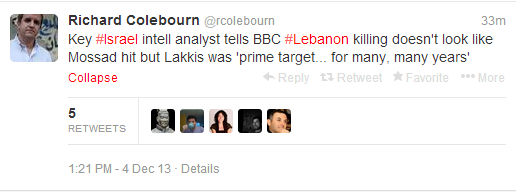
Colebourn Lakis tweet
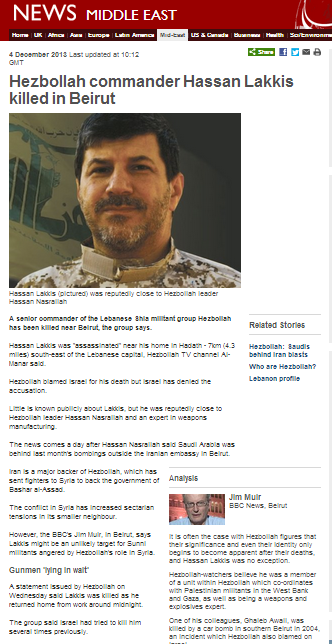
Lakis art 1
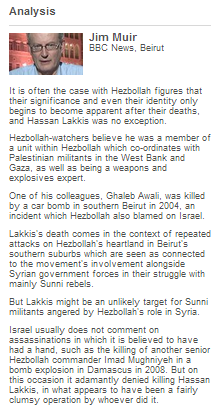
The article as it currently stands at the time of writing, together with the side box of analysis by the BBC’s Beirut correspondent Jim Muir, totals 666 words – with the words ‘Israel’ and ‘Israeli’ being used nine times. Muir sidebox Lakis
In the body of the article readers are told that:
“Hezbollah blamed Israel for his death but Israel has denied the accusation. […]
“The group [Hizballah] said Israel had tried to kill him several times previously.” […]
“Israel denied any involvement in the death.”
“These automatic accusations are an innate reflex with Hezbollah,” Israeli foreign ministry spokesman Yigal Palmor said. “They don’t need evidence, they don’t need facts. They just blame anything on Israel.” […]
“Hezbollah fought a destructive 34-day war with Israel in 2006. The group said that one of Lakkis’s sons had been killed in that conflict.”
In his sidebox of analysis Muir writes:
“One of his colleagues, Ghaleb Awali, was killed by a car bomb in southern Beirut in 2004, an incident which Hezbollah also blamed on Israel.” […]
“Israel usually does not comment on assassinations in which it is believed to have had a hand, such as the killing of another senior Hezbollah commander Imad Mughniyeh in a bomb explosion in Damascus in 2008. But on this occasion it adamantly denied killing Hassan Lakkis, in what appears to have been a fairly clumsy operation by whoever did it.”
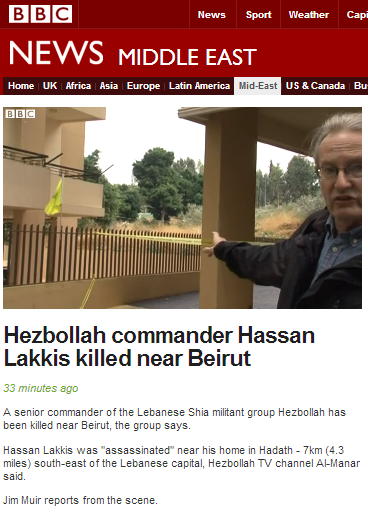
In a filmed report broadcast on BBC television news and also placed on the BBC News website, Muir repeated the Hizballah line.
“But of course Hizballah itself has been very quick to blame Israel for this killing – something the Israelis have denied. Now normally, if they have had a hand in something, or it’s believed they have, they keep quiet – they say absolutely nothing.”
Muir filmed Lakkis
So busy is the BBC repeating and promoting the baseless propaganda of a terrorist organization, that exploration of the possibility that the assassination might have been carried out by any actor which is not Israel is reduced to one vague sentence in Muir’s analysis, which was repeated in the body of the main article’s earlier versions – including the decidedly curious use of the term “unlikely target”.
“But Lakkis might be an unlikely target for Sunni militants angered by Hezbollah’s role in Syria.”
Likewise, the terrorist organisation’s role in the Syrian civil war is also downplayed, both in the article itself and in Muir’s sidebox.
“Iran is a major backer of Hezbollah, which has sent fighters to Syria to back the government of Bashar al-Assad.”
“Lakkis’s death comes in the context of repeated attacks on Hezbollah’s heartland in Beirut’s southern suburbs which are seen as connected to the movement’s involvement alongside Syrian government forces in their struggle with mainly Sunni rebels.”
Notably, the article fails to make clear to readers Hizballah’s designation as a terrorist organization which is operational worldwide, describing it thus:
“Hezbollah – or the Party of God – is a powerful political and military organisation in Lebanon made up mainly of Shia Muslims.
It emerged with financial backing from Iran in the early 1980s and began a struggle to drive Israeli troops from Lebanon.”
As Michael Totten has noted:
“And yet Hezbollah is still often described, by itself and by its Western apologists, as an indigenous Lebanese “resistance” movement in a twilight struggle against the Jewish state. It is, in fact, a multinational terror operation with Iran as its funder and controller.”
The BBC article also states that:
“Little is known publicly about Lakkis, but he was reputedly close to Hezbollah leader Hassan Nasrallah and an expert in weapons manufacturing.”
As is documented in Matthew Levitt’s recently published book, Lakkis was previously also responsible for Hizballah’s procurement of arms and military equipment.
“In 2001, Mohammad Dbouk was indicted in U.S. federal court under Operation Smokescreen. According to U.S. investigators, Dbouk is an Iranian-trained Hezbollah operative and “an intelligence specialist and propagandist [who] was dispatched to Canada by Hezbollah for the express purpose of obtaining surveillance equipment.” According to information collected by the Canadian Security Intelligence Service (CSIS) during its investigation into Mohammad Dbouk’s activities in Canada, first in Montreal and then in Vancouver, Dbouk was acting under the direction of Hezbollah’s then chief of procurement, the aforementioned Haj Hassan Hilu Laqis, who was based in Lebanon.” [emphasis added]
Just a couple of weeks ago the BBC was amplifying Iranian propaganda on the subject of the terror attack on the Iranian embassy in Beirut – see here and here.  In this article (as well as in a separate one) it now adds Hizballah propaganda to its cocktail of unfounded accusations surrounding that incident.
“The news comes a day after Hassan Nasrallah said Saudi Arabia was behind last month’s bombings outside the Iranian embassy in Beirut.”
The BBC clearly has a problem knowing how to relate to the streams of all too predictable propaganda regularly produced by regimes and terrorist organisations in the Middle East. Its current practice of uncritical repetition and amplification of baseless rumour, conspiracy theories and propaganda is clearly incompatible with its obligation to “build a global understanding of international issues” and its self-declared aspiration to “remain the standard-setter for international journalism”.
The BBC’s remit is to help audiences look beyond the propaganda and rhetoric they can just as easily view on websites and television stations run by Hizballah or the Iranian and Syrian regimes rather than giving it inappropriate credence through uncritical repetition and amplification on its own website and television news
---------