Showing posts with label Harriet Sherwood. Show all posts

Sunday, 26 January 2014

Farewell Harriet - Please don't come back


WE ARE SORRY FOR THE SWEAR WORDS BUT WE FEEL IT FITTING FOR SUCH A PERSON

Nothing is more ludicrous than the Guardian Rag, sorry I mean newspaper. Harriet Sherwood, it's Middle East reporter is going back home to the UK after two years of lying, covering up for terrorists and generally being a thorn in everyone's side. The Guardians story covering her departure would in itself be laughable if it wasn't so tragic, considering the innocent lives lost due to those that Middle class bitch covers up for. The first paragraph goes:

 "After three years reporting on the Palestinian-Israeli conflict, our Middle East correspondent is coming home to the UK. With heavy heart she pays a farewell visit to Gaza and pays tribute to the resilience, creativity and humour of its people"

"Resilience" "Creativity" "Humour" 

Is this woman serious? 
I wonder if the maimed and injured Israelis from the rockets fired by Harriet's citizens from Gaza, I wonder if they regard their lost limbs and mental scars as a sign of 'creativity?" Or I wonder if the families of loved ones lost due to a school being hit by a rocket fired from Harriet's 'resilient' Gazans , I wonder if they find it "Humorous?"

Somehow I doubt it.

So as she says goodbye with tears in her liberal eyes all we can say is "Piss off back to the UK, as Kerry can piss off back to the US, and both of you please don't ever come back" :-)

Thursday, 19 December 2013

Murdered Israeli fails to evoke the Guardian’s sympathy


As we noted in a post yesterday, the Guardian’s Harriet Sherwood evidently believes – contrary to all evidence – that Palestinian terrorist attacks in Judea and Samaria (the West Bank) are rare.  
However, the only thing truly rare is substantive coverage by the Guardian of ubiquitous terror attacks(and attempted attacks) on Israelis inside and outside the green line.  A case in point is their “coverage” of the murder of Eden Atias, the 19-year-old from Nazareth Illit who was stabbed to death by a Palestinian teen on a bus at Afula’s central bus station.  
Their sole piece on the lethal terror attack consisted of a generic video they posted on Nov. 13 (with NO accompanying text) which has since been removed.  When you open the link to Harriet Sherwood’s “report”, all you see is the headline and a message below inserted by editors which notes that the content has been removed.
The Guardian’s tendency to downplay Palestinian attacks on Israelis was again on display following the death on Sunday of 31-year-old Master Sgt. Shlomi Cohen, from Afula, who was killed (while driving an army vehicle) by cross-border gunfire from Lebanon.  The following morning, the Guardian published a story on the incident by Conal Urquhart titled ‘Lebanon-Israel border shooting sparks tensions‘.  
orig headline
(It was in the strap line where we first learned that an Israeli soldier was killed.)  
Though the precise details of the shooting are still being investigated, reports confirm that the gunman was a member of the Lebanese Armed Forces and that he fired several bullets from Lebanese territory at Cohen, who was on the Israeli side of the fence.
The Guardian chose to illustrate the story with the following photo of the Israel-Lebanon border.
Lebanon-Israel border shooting sparks tensions
Several hours after the shooting, the IDF reportedly fired shots in the direction of Lebanese soldiers in the same area where Cohen was killed, after spotting “suspicious movement” – though there are conflicting reports as to whether any Lebanese soldiers were actually wounded in the incident.
Roughly 12 hours later (and 14 hours after Urquhart’s original story), Harriet Sherwood published her report on the day’s events in a story titled ‘Israeli troops shoot two Lebanese soldiers in border skirmish‘.
headline(Again, the fact that the shooting took place only after an Israeli soldier was killed is relegated to the strap line.)
The photo Guardian editors used to illustrate the incident was an unrelated photo of Israeli soldiers which dates back at least five years.
Israeli troops near Lebanon
Whilst the report itself is relatively fair, it’s nonetheless troubling that in two stories devoted to an incident which clearly began when an Israeli soldiered was killed by a Lebanese soldier, neither the titles nor accompanying photos convey any information about the Israeli victim.  Additionally, in looking back at prior Guardian reports on lethal Palestinian terror attacks over the past two years, we weren’t able to find even one which included a photo of the Israeli victim.  
The Guardian’s failure to humanize Israeli victims of terror stands in stark contrast to their often fawningcoverage of Palestinian terrorists and their families.
Photo of Shabbir Hazam used to illustrate Guardian story: He was a member of Fatah who was sentenced to life imprisonment for murdering a work colleague – Holocaust survivor Isaac Rotenberg – with an axe.

Here’s one of the photos of Shlomi Cohen used by other media outlets, which the Guardian passed on.
cohen1
Here’s his final Facebook update:
cohen's
Cohen leaves behind a wife and seven-month-old baby girl. 

Tuesday, 17 December 2013

Harriet Sherwood adaciously suggests that Palestinians have abandoned terror

All Harriet needs for Christmas is a new brain.
One of the many articles published in early November by the Guardian about the Swiss report on the death of Yasser Arafat concluding that the late Palestinian leader was likely poisoned – a theory contradicted by a subsequent  French report - was penned by Harriet Sherwood, and titled Arafat polonium find likely to be another hurdle for peace talks.  
Sherwood’s story strangely argued that the Swiss findings were “likely to worsen the already corrosive atmosphere of the faltering peace negotiations and fuel popular demands that the Palestinian leadership walk out”, and, we noticed after reviewing the article again, this even more curious conclusion about Palestinians.
Arafat was a man who divided the world: revered by Palestinians and their supporters, reviled by Israel and its allies. Nine years after his death, a portrait of him still hangs in most Palestinian homes. Nonetheless, the Palestinian people have inevitably moved on. Acts of violence, espoused by Arafat, are rare in the West Bank, and rocket fire from Gaza has dropped; instead, the Palestinian leadership has invested its hopes in diplomacy and negotiations.

The broad suggestion that Palestinians have largely abandoned Arafat’s ‘strategy’ of terrorism represents an almost staggering distortion based on empirical data on the quantity of terror attackssince his death.  (In 2005 alone, 2,990 Palestinian terror attacks were recorded.)  Further, though such attacks have decreased overall in comparison to the height of the 2nd Intifada, this reduction is largely attributed to the construction of Israel’s security fence and more effective counter-terror measures, not changing Palestinian attitudes towards terror.
Additionally, Sherwood’s claim that “acts of violence…are rare in the West Bank” is also simply not true.  As BBC Watch’s Hadar Sela recently reported, “statistics provided by the ISA [Israel Security Agency] for the months July to November 2013 shows that the number of terror attacks taking place in Judea and Samaria [the West Bank] and Jerusalem since the renewal of direct negotiations between Israel and the PLO on July 29th has more than doubled”. 

Terror incidents since July, 2013.

Sherwood’s additional claim that “rocket fire from Gaza has dropped” is also extremely misleading.  As the graph below on rocket attacks from Gaza demonstrates, rocket attacks from Gaza increaseddramatically since Arafat’s death in 2004 (and Hamas’s control of the Strip in 2006).   While rocket attacks did decrease following the Gaza war (Cast Lead) in 2008-09, they increased again each year after the conflict until Israel launched an eight-day war in November 2012 (Pillar of Defense).

graph
Beyond the statistical evidence contradicting Sherwood’s specific claims, it’s hard to understand how anyone covering the region as long as she has could possibly come to the conclusion that Palestinians have in any way abandoned terrorism.  In addition to the ubiquitous examples of the Palestinian glorification of terrorists, a comprehensive report on Arab public opinion by Pew Global in September demonstrated that “support for suicide bombing and other violence aimed at civilian targets is most widespread in the Palestinian territories“.  A staggering 62% of [Palestinian] Muslims, per this poll, believe that such attacks “are often or sometimes justified in order to defend Islam from its enemies”.

pal terrorism support
Though we’ve, on occasion, noted reports by Sherwood which suggest a modest amount of improvement in her coverage of the region, the amount of disinformation conveyed in those two sentences we cited (on Palestinian attitudes towards terror) again reminds us that her pro-Palestinian sympathies will trump a sincere commitment to accuracy almost every time.

Wednesday, 4 December 2013

Harriet Sherwood refers to future Israeli cities in the Negev as “Jewish settlements”


Harriet Sherwood’s Guardian report on Dec. 1, ‘Israel’s plan to forcibly resettle Negev Bedouins prompts global protests‘, focuses on objections to the so-called Prawer-Begin plan to resettle some of the Israeli Bedouin population in the Negev from unplanned encampments to planned communities.  
bedouin
(Under the plan, out of about 210,000 total Israeli Bedouin, roughly 30,000 will move, most only a few kilometers from their current homes, and will be compensated for their land.  Another 60,000 will have their homes legalized and developed under the initiative, per the graphic below.)
MFA graphic
MFA graphic
However, even more interesting than Sherwood’s disproportionate focus on an extremely small number of protesters in Israel (and a few cities abroad), is the extremely telling words she uses to describe the new planned Israeli towns which will replace the existing encampments.  
Sherwood writes the following:
Under the Prawer Plan, the residents of “unrecognised” villages will be moved into seven overcrowded and impoverished towns. Meanwhile, new Jewish settlements are planned for the region.
First, as with all Israeli cities, citizens of all faiths will be permitted to live in all new communities built in the Negev, and it is therefore inaccurate to describe them as “Jewish”.
Even more noteworthy, however, is her use of the word “settlements” to characterize these future towns.  These new cities, such as Hiran (currently a cluster of Bedouin encampments in what’s called Umm al-Hiran, 30 km from Beer Sheva), will be established in the Israeli Negev – that is, within the state’s boundaries as they were envisioned even under the UN Partition Plan of 1947, and as the boundaries were established under the 1949 armistice agreement.
Here’s a map of the area:
hiran map
Black arrow in upper right points to 1949 Armistice Lines – above which is the West Bank/Judea & Samaria. The Green arrow points to approximate location of Hiran.
Previously it seemed that the Guardian’s unofficial policy was to merely refer to Israeli communities in the West Bank (Judea and Samaria) as “settlements”.  
However, the term “settlement” seems to have now taken on a more expansive definition: any place within the state (even within its ‘recognized’ 1949 boundaries) previously free of Jews but where Jews are now permitted to live.
------------

Thursday, 7 November 2013

Is a lie of omission still a lie? Guardian report failed to include key words in Lieberman quote


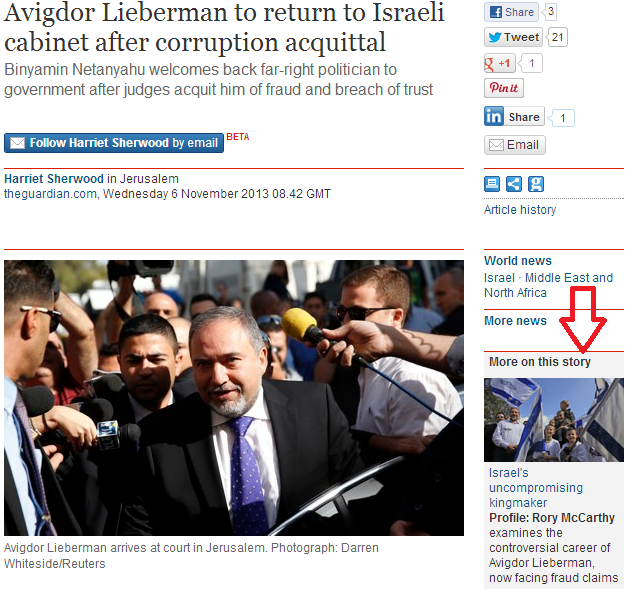
Harriet Sherwood published a report today, Nov. 6, on the acquittal of Avigdor Lieberman, titled ‘Avigdor Lieberman to return to Israeli cabinet after corruption acquittal‘. Whilst there is nothing especially problematic in Sherwood’s report about Lieberman, who was cleared on charges of fraud in a unanimous ruling by three judges after a lengthy trial, we noted a related ‘recommended’ article on the right side bar:
lieberman
The 2009 article, by the paper’s former Jerusalem correspondent, Rory McCarthy, is a profile of the Yisrael Beiteinu party leader (and former foreign minister), titled ‘The rise of Israel’s foreign minister‘, which includes the following claim:
In typically blunt terms Lieberman has called for the trial and execution of Arab fellow MPs.
However, upon researching the claim it became clear that McCarthy omitted a few words in Lieberman’s quote, which go back to comments attributed to him in May, 2006. Here’s a translation of a Hebrew media report on what he said on the floor of the Israeli Knesset:
Lieberman called the execution of Arab Israeli MKs who met with the Hamas…
Whilst Lieberman’s comments were still, quite obviously, extremely inflammatory (and were condemned at the time by Prime Minister Ehud Olmert as an act of “incitement”), Guardian readers who come across McCarthy’s report could likely believe (falsely) that Lieberman was calling for death sentences to be carried out arbitrarily against Arab members of the Israeli Knesset.
It’s quite notable that other news sites (even ones not typically friendly to Israel) got the 2006 Lieberman quote right, including even Electronic Intifada (EI).  An EI post shortly after Lieberman’s comments were published included the following:
A few days previously, on 5 May, Lieberman expressed the hope that Arab legislators who met with the Hamas leadership be put on trial and executed
Interestingly, even McCarthy’s colleagues have accurately reported his comments.
Extreme left Guardian columnist Jonathan Steele got the quote correct in a 2006 essay, which included the following:
Lieberman has described Tibi and other Israeli Arabs who have met Hamas officials as traitors. They should be executed, he said…
Here’s Peter Beaumont – foreign editor of The Observer, sister publication of the Guardian - in 2012:
 At various times he has called for the expulsion of Israel’s Arab population, [and] the “execution” of Arab MPs who met with leaders of Hamas,
Bottom line?  
A ‘lie of omission’ is still a lie.
CIF