Showing posts with label Gaza tunel. Show all posts

Wednesday, 13 November 2013

Security and defense: A reminder of Gaza's terror industry


Hamas is working hard to rebuild terrorist capabilites lost during the last round of hostilities with Israel during Operation Pillar of Defense in November 2012.

This week's revelation of a massive Hamas attack tunnel stretching from southern Gaza to Israel's Eshkol region is a reminder that the terrorism industry in Gaza is pushing ahead at full throttle, in anticipation of the day that the cease-fire between Hamas and Israel will come to an end.

The proportions and engineering of the latest tunnel exposed by the IDF are staggering: It is 1.7 kilometers long and 1.80 meters tall, complete with an electricity supply and telephone communications.

Some 24,000 cement slabs were used in its construction, to reinforce the subterranean structure; this was cement Israel sent to Gaza in order to assist the civilian construction sector.

In light of the fact that it was the third tunnel to be uncovered this year, the IDF is working on the assumption that there are more undiscovered tunnels out there, and that Hamas is going to continue to try and dig its way under army forces patrolling the border, toward frontier towns and villages.

The tunnels present a double threat to Israeli security. The first lies in Hamas's ambitions to capture and kidnap IDF soldiers to trade for the release of Palestinian security prisoners in Israeli jails, in a bid to replicate their successful Gilad Schalit exchange.
The second threat involves a scenario of Hamas gunmen walking through the tunnels under the border and sneaking into a civilian community to carry out a terrorist atrocity.

The tunnel is just one aspect of a wider Hamas effort to rebuild its guerrilla military and terrorist capabilities following its bruising clash with Israel in November 2012. These efforts include restocking its short- and medium-range rockets. Hamas has at least 5,000 short-range rockets that put southern cities like Ashkelon and Ashdod in range, and is attempting to create a new arsenal of rockets that can hit Tel Aviv and Jerusalem.

It is training and building up its fighting forces, composed of 16,000 armed men.

On the Israeli side of the border, the IDF isn't resting on its laurels. The Southern Command is enjoying an unprecedented level of intelligence on Hamas's activities (as well as information on Islamic Jihad and smaller al-Qaida-affiliated organizations in Gaza). This intelligence can, in any future round of fighting, guide the IDF's devastating guided firepower. From the air, the IAF can hit well over 1,000 targets daily, and a ground offensive would threaten Hamas's future existence as a ruling regime.

On a day-to-day basis, the IDF deploys heavy border patrols and monitors Gaza, with the help of advanced border and aerial surveillance systems.

Aware of Israel's might, Hamas is playing a delicate balancing act, seeking to prepare surprises for Israel without directly attacking it from Gaza.

The fact that Hamas is completely isolated in the region only contributes further to Israeli deterrence against it.

With the fall of the Muslim Brotherhood from power in Cairo, Hamas's ambition to fall under the wings of its fellow Egyptian Islamists and set up a regional alliance of Islamist entities to threaten Israel, has been replaced with an anxious search for new allies, and an attempt to fall back into the Iranian orbit.

The Egyptian military administration, under the leadership of Gen. Abdel Fatah al-Sisi, has identified Hamas as a hostile branch of its domestic foe the Muslim Brotherhood, and sees Gaza as a dangerous strip of land that can be used by terrorists to smuggle weapons and fighters into Sinai to attack the Egyptian army.

As a result, Egypt's military has sealed off many smuggling tunnels linking Sinai to Gaza, contributing to Hamas's growing isolation.

Deterrence and isolation should keep the ceasefire with Hamas going for a while longer, but Hamas's increasingly desperate situation might push it towards strategic errors and cause it to attack Israel.

Hence, the IDF felt the need to reemphasize its intentions to hit Hamas very hard should it decide to use one of the tunnels soon.

"This is the third tunnel we've found this year," Southern Command chief Maj.-Gen. Sami Turgeman told reporters this week, speaking near the tunnel's entrance.
"It constitutes a gross violation of Israeli territory.

If Hamas carries out a terrorist attack, it will pay a heavy prize, and Gaza will look different afterwards," he warned.

By telling Hamas that Israel is serious about using overwhelming force in the event of a breakdown in the cease-fire, the IDF increases the chances of maintaining the current period of calm.

Jerusalem post 

Tuesday, 15 October 2013

BBC not sure cross-border tunnel intended for terror?


On countless occasions BBC audiences have repeatedly read or heard permutations of the following message, with the implication being that Israeli concerns regarding the misuse of construction materials entering Gaza are in fact much ado about nothing.
“Israel continues to enforce tight restrictions on the amount of building materials allowed into Gaza, saying they could fall into the hands of Hamas and be used for military purposes.”
A grossly inaccurate, partial and out of date BBC backgrounder titled “Guide: Gaza under blockade” which still appears on the BBC News website even goes so far as to state that:
“Israel says Hamas has diverted aid in the past, and could appropriate building materials for its own use. Aid agencies say they have stringent monitoring systems in place.” A soldier investigating the Gazan terror tunnel that lead into Israeli civilian communities, the same type that was used to kidnap Gilad Shalit.
The announcement on Sunday, October 13th 2013 regarding the IDF’s discovery of a 1.7 kilometer long, 18 meter deep, concrete-clad tunnel spanning the border between the Gaza Strip and Israel should surely put paid to any further insinuations that control of the entry of building materials into the Gaza Strip is an unwarranted product of Israeli exaggeration. Obviously, the suspicion that building materials intended for civilian reconstruction projects are being expropriated by Hamas for military use is not unfounded and impartial journalists will now of course be investigating that diversion of resources from the civilian sector.  
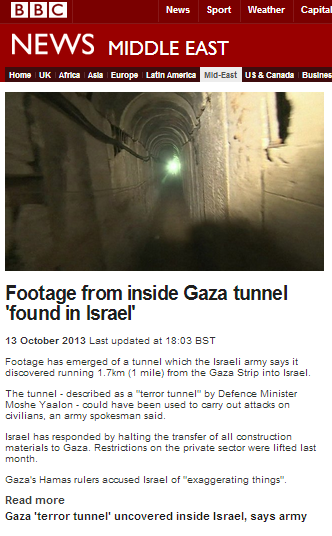
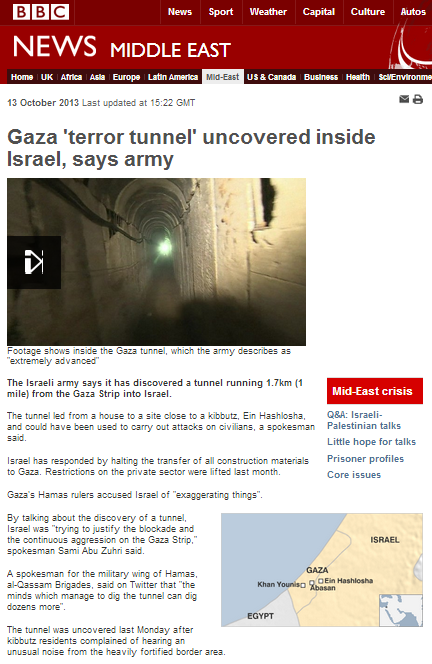
Despite its “smaller operation at the weekend“, the BBC News website produced an article on the subject within hours of the announcement. On the website’s Middle East homepage, visitors could opt for a filmed report or a written one – both of which displayed interesting use of scare-quotes in their headings.
terror tunnel hp 2
tunnel filmed
tunnel written
Does the BBC really think that the intent of the tunnel might not have been for purposes of terrorism, or that it might not have been found in Israel – as its choice of punctuation implies?
As one BBC Watch reader pointed out to us, that use of punctuation is particularly noticeable in contrast with the headline to a domestic story which appears concurrently on the website’s main page.
terror BBC hp
In the written version of the article – which has undergone considerable changes (including to its title) since its initial publication – and in the synopsis to the filmed item, readers are told that:
“Israel has responded by halting the transfer of all construction materials to Gaza. Restrictions on the private sector were lifted last month.” [emphasis added]
This is not the first time that the BBC has misled audiences in relation to the entry of construction materials for the private sector to the Gaza Strip: back in August the BBC Jerusalem Bureau’s Yolande Knell made similar claims. In fact, restrictions were further relaxed – rather than “lifted” – with theamount of materials entering the Gaza Strip for use in the private sector having been raised in September 2013 from twenty truckloads per day to seventy. 
The written article also states:
“Israel tightened a blockade on Gaza when Hamas took power in 2007.”
That misleading pro-forma line has been used in many other BBC News articles in the past. As we have previously noted here:
“The violent Hamas take-over of Gaza took place between June 5th and 15th 2007 and the Palestinian Authority – the internationally recognized representative of the Palestinian people – was forcefully ejected from power. Following that event, both Egypt and Israel largely closed their borders with the Gaza Strip due to the fact that the body charged with joint security arrangements under the terms of the Oslo Accords – the Palestinian Authority – no longer exercised any control over the territory. 
Three months later – on September 19th 2007 – in light of the escalation of terrorist rocket attacks against Israeli civilians originating in the now Hamas-controlled Gaza Strip – the Israeli government declared Gaza to be ‘hostile territory’.
“Hamas is a terrorist organization that has taken control of the Gaza Strip and turned it into hostile territory. This organization engages in hostile activity against the State of Israel and its citizens and bears responsibility for this activity.
In light of the foregoing, it has been decided to adopt the recommendations that have been presented by the security establishment, including the continuation of military and counter-terrorist operations against the terrorist organizations. Additional sanctions will be placed on the Hamas regime in order to restrict the passage of various goods to the Gaza Strip and reduce the supply of fuel and electricity. Restrictions will also be placed on the movement of people to and from the Gaza Strip. The sanctions will be enacted following a legal examination, while taking into account both the humanitarian aspects relevant to the Gaza Strip and the intention to avoid a humanitarian crisis.”
It is a pity that an otherwise reasonable article is marred by such sloppy inaccuracies and bizarre use of punctuation.