Showing posts with label Yom Kippur war. Show all posts

Monday, 21 October 2013

How One IDF Commander Turned Back a Syrian Column in the Yom Kippur War


With just one tank, Captain Zvika Greengold withstood the might of the Syrian military. As the battle around him raged, he moved in and out of the darkness, firing at Syrian forces while remaining undetected. He persisted heroically for hours, throwing himself at the enemy in the face of almost certain death.
On October 6, 1973 – the first day of the Yom Kippur War – the Syrian military bombarded Israel’s northern border. At exactly 2:00 pm, its air force and artillery pounded IDF positions in the Golan Heights in coordination with an Egyptian strike in the Sinai Peninsula. Hours later, Syrian tanks and troops crossed the border and invaded Israeli territory. The IDF soldiers, suffering tremendous losses, scrambled to stop the Syrian onslaught.

Israeli_Tank_Battles_Egyptian_Forces_in_the_Sinai_Desert_-_Flickr_-_Israel_Defense_Forces

Meanwhile, Captain Zvi “Zvika” Greengold, a 21-year-old tank commander, frantically left his home on a kibbutz near Haifa. Before the war, he had been granted two weeks’ leave before beginning a course for commanders. When he learned of the Syrian attack, he made his way northward to the Golan, where IDF forces were growing increasingly outnumbered.
In the late afternoon, Cpt. Greengold reached Nafah – an IDF command center in the Golan’s southern sector. Determined to join soldiers in the battlefield, he took command of two tanks and assembled scratch crews to run them.  He made contact with troops in the southern sector and advanced toward them, identifying his tanks over radio as ‘the Zvika Force.’ With night falling, he set out along the Tapline Route – a road in the Golan Heights used by Syrian forces to enter Israeli territory.

Cpt. Zvi "Zvika" Greengold
Cpt. Zvi “Zvika” Greengold – One against many

Moments later, Cpt. Greengold discovered a company of Syrian tanks moving toward Nafah. With two tanks, he faced slim chances of success against the Syrian forces, but he was determined to protect the Israeli command center. In a heroic act, he began to coordinate an attack on the company. For hours, he persisted with extraordinary bravery, throwing himself at the enemy in the face of almost certain death.

Battle on the Tapline Route
Cpt. Greengold’s crew took partial cover beside the road and waited for the Syrian tanks to approach. When he spotted the first Syrian tank, he rapidly opened fire. The blast from his vehicle hit the Syrian tank and ignited it, generating a shock that destroyed his own radio communications. Left unable to communicate, he jumped out of his vehicle and ran to the second tank in the heat of battle.
Cpt. Greengold traded places with the second tank’s commander and ordered him to follow his lead. But as the two vehicles moved down the road, the other tank soon lost its direction in the darkness. With no way to locate the other half of his force, Cpt. Greengold realized that he would need to face the remaining Syrian tanks alone.

Map of Syrian Invasion October 6 1973
Several minutes later, Cpt. Greengold beheld a shocking site – a long column of Syrian tanks moving steadily along the road. Despite being outnumbered, he moved in and out of the darkness, firing on the Syrian tanks while remaining undetected. As the battle raged, he changed his position constantly, firing from different directions to give the perception of a much larger force. In attempt to uncover the Israeli forces, the Syrian tanks turned on their searchlights but discovered nothing. The beams of light only helped Cpt. Greengold identify more Syrian tanks and inflict greater losses. The Syrian forces, stunned by the attacks, retreated to avoid further casualties.
Meanwhile, Syrian tanks continued to pour over the northern border. Late at night, Cpt. Greengold joined two platoons of reserve tanks to stop the Syrian advance. Moments into battle, a Syrian tank fired on Cpt. Greengold, lighting his tank on fire and badly burning his crew. Although he suffered from burns and shock, he ran to another tank and took command over its crew. He continued in this way for hours, striking at Syrian tanks and changing vehicles whenever his tank was disabled.
The fight for Nafah
Before dawn on October 7, the Zvika Force joined other troops along the Tapline Route, where they confronted the Syrian 51st Tank Brigade. Although Israeli forces gained the upper hand, they received urgent orders to return to Nafah – where Syrian tanks were on the verge of breaking Israel’s defenses.
syrian-tanks-destroyed

At noon, eighty T-62s – the most advanced tanks in the Syrian military – were poised to take the Israeli command center.  Understanding the dangers on the Tapline Route, Cpt. Greengold drove off the road and reached the command center without encountering Syrian forces. When he arrived with the 679th Reserve Armored Brigade, IDF forces were withdrawing as Syrian tanks entered the base.
As the enemy forces fired wildly, a Syrian tank pointed its gun toward an Israeli anti-tank unit inside Nafah. Cpt. Greengold spotted the Syrian tank and fired, destroying the Syrian vehicle and saving the lives of the Israeli soldiers.  He continued to shoot at the Syrian forces, replacing his gunner who was too exhausted and shocked to function. Although Nafah was nearly lost, the tables began to turn in Israel’s favor. After a brutal fight, the IDF forces overcame the Syrian tanks and pushed them out of the base.
After more than twenty hours of battle, Cpt. Greengold exited his tank in the middle of the Nafah base. Exhausted from the non-stop combat, he fell to the ground. An intelligence officer embraced Cpt. Greengold and brought him to an IDF medical center, where Cpt. Greengold was treated for his injuries.

Zvika Greengold today serves as Mayor of Ofakim
Zvika Greengold today serves as Mayor of Ofakim, a city in southern Israel
After the Yom Kippur War, the IDF awarded Cpt. Greengold with a Medal of Valor for hisextraordinary heroism. He is one of only eight soldiers to earn the medal after fighting in the war. After leaving the IDF, he became a successful businessman, leading two Israeli companies. Today, he serves as Mayor of Ofakim, a city in southern Israel. He is married and the father of three children.

Wednesday, 16 October 2013

The Life of a Yom Kippur War Widow


For Ora and Nechemia, it was love at first sight. They felt they were meant to be together. But just as they began to build their life together, the Yom Kippur War broke out and changed everything. This is the story of Ora Graiver-Dobrish, widow of one of the 2,691 soldiers who lost their lives in the Yom Kippur War of 1973.
“If it wasn’t for this, my life would have been so different,” says Ora Graiver-Dobrish, widow of a Staff Sergeant Nechemia Dobrish, a soldier who fell defending Israel in the Yom Kippur War.
Ora and Nechemia met as teenagers in Petah Tikvah in the early 1960s. Through school, their local Bnei Akiva youth group and a ballroom dancing club, the two friends soon became a couple. “We were meant to be together,” she says of her and Nechemia.
In 1965, Nechemia was drafted into the Israel Defense Forces and served in the Artillery Corps. He was a talented soldier and even went through the process of becoming an officer before deciding to pursue a career in law, graduating from Tel Aviv University.


By 1973, Ora and Nechemia were married with a young son, Yaron. Nechemia was in the process of studying for the bar exam, the last step before becoming a lawyer. Once the Yom Kippur holiday rolled around, Nechemia put down his law books for what he thought would be one day. The day of Yom Kippur, however, Ora began seeing army vehicles filled with soldiers on the street. She knew something strange was going on. A few hours later, Nechemia himself was called up for draft duty. Nine days later, in the midst of the Yom Kippur War, Nechemia was with his unit fighting a battle against the Syrian army in the Golan Heights when he was shot in the back of the thigh.
He was immediately rushed to the intensive care unit of Ziv Hospital. That same day, back at the Dobrish’s home in Petah Tivka, Ora noticed people lingering near her building’s entrance as she returned home from a walk. Seconds after arriving home, there was a knock on her door. Two officers and the family doctor were there to tell her that Nechemia was in the hospital.
Ora rushed to the hospital as fast as she could with Nechemia’s sister Chava. Doctors said her husband was in critical condition, but she did not expect the worst. “I thought it meant he had a bad injury to his arm or leg,” she recalls. Within 48 hours, Nechemia was gone.
Ora still has the piece of shrapnel that was removed from Nechemia's leg.
Ora still has the piece of shrapnel that was removed from Nechemia’s leg.

Ora became a widow at age 26, but still managed to go on with life, even without her soulmate. Ora remains a positive person to this day despite the tragedy she has endured. She eventually remarried, had two more sons, one of whom is an officer in the Israel Navy, and built a career in the insurance industry. She remains close with Nechemia’s family, especially his sister.
To this day, though, the loss of Nechemia in defense of the state is still felt by those who knew him, especially his wife. “I will never forget Yom Kippur, 1973 for as long as I live.”

Tuesday, 8 October 2013

BBC Yom Kippur war accuracy failure perpetuated over years


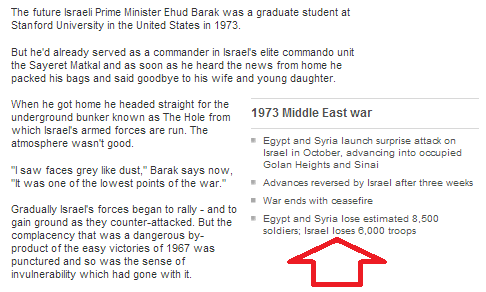
An article by the BBC Jerusalem Bureau’s Kevin Connolly titled “Legacy of 1973 Arab-Israeli war reverberates 40 years on” which appeared in the ‘Features & Analysis’ section of the BBC News website’s Middle East page on October 5th 2013 includes a side-box according to which:
 ”Egypt and Syria lose estimated 8,500 soldiers; Israel loses 6,000 troops”
side box connolly article
That same claim is also to be found in previous BBC articles on the subject of the Yom Kippur war – for example here in the backgrounder titled ‘A History of Conflict’ which is undated, but appears to come from around 2005.
HoC 1973
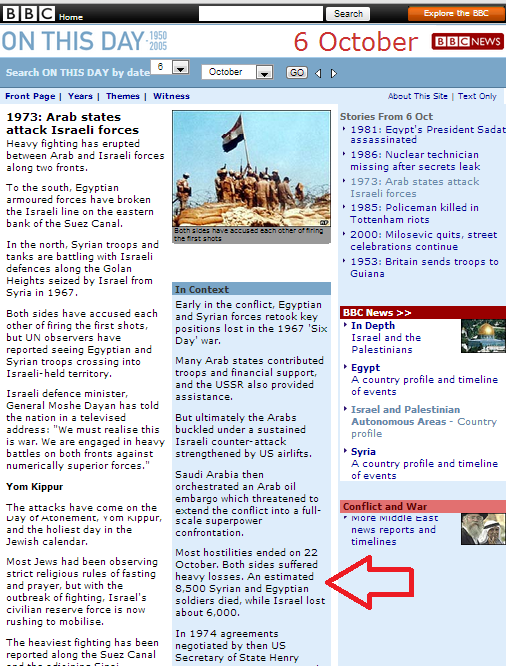
It also appears in another side-box of ‘context’ appended to an ‘On This Day’ feature – also undated, but apparently from around 2005 at the latest. 
OTD casualties YK
But in fact, that number does not accurately represent the number of Israeli casualties in the Yom Kippur War.
According to the Israeli Ministry of Defence archives - quoting the preface to the report of the Agranat Commission in 1974 – 2,222 Israeli soldiers were killed, 7,251 injured, 301 taken prisoner and 16 declared missing in action during the Yom Kippur War. The Knesset website cites 2,350 Israeli casualties, 15,000 Egyptian ones and 3,500 Syrian dead. Other sources quote figures of between “more than 2,500“, 2,569, 2,688 and 2691 Israeli casualties, with the differences probably being attributable to later deaths as a result of injuries sustained, MIAs whose status was later confirmed and prisoners of war who did not return alive. With regard to Egyptian and Syrian casualties, reliable information is sparse and so the estimates vary.
Despite the differing estimates of Israeli casualties, none of them reaches even half of the 6,000 claimed in this BBC article and others. Interestingly, casualties recorded during the 1948 War of Independence do stand at over 6,000 Israelis (soldiers and civilians), so perhaps we can conclude that the BBC has mixed up its Middle East wars.  
This example of failure to meet the expectations of accuracy as stipulated in the BBC editorial guidelines raises an additional interesting point beyond the error itself. The fact that the same inaccuracy has been repeated in article after article over a period of several years suggests that the BBC lazily relies on its own sources – and hence perpetuates its own mistakes – rather than engaging in proper fact checking. 
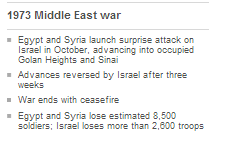
revised version YK
The two backgrounders still cite the inaccurate number at the time of writing. 

BBC Whatch

40 Years Since the Yom Kippur War #1: The First Strike

40 years ago, during Yom Kippur, Israel faced one of the biggest challenges of its history. On October 6, hundreds of thousands of troops, thousands of tanks and fighter jets attacked simultaneously, surprising Israel at its northern and southern frontiers. Syria and Egypt were determined to get back what they had lost during the Six Day War. For the 40th anniversary of the Yom Kippur War, follow our series and learn about the major milestones of the conflict.

The historical context

After the Six Day War in 1967, Israel gained new territories and therefore faced new challenges. The IDF had to guard the Sinai border along the Suez Canal, where it installed numerous posts on what was called the Bar-Lev line. The Golan Heights was also new territory for the IDF to defend.
After they were swiftly defeated in the Six Day War, the Arab countries surrounding Israel wanted to redeem themselves, and sought to regain lost territories. From 1972, the Egyptian and Syrian militaries rebuilt themselves from the ground up. They acquired up-to-date equipment, mainly through the USSR: MiGs, T-55 and T-62 tanks, anti-aircraft missiles (SA2-3-6-7) and Sagger anti-tank guided missiles. By October 1972, Anwar Sadat, President of Egypt, was already speaking about attacking Israel in private meetings with his army staff.
Map of Israel in 1967
By May 1973, it was clear to the Military Intelligence Directorate of the IDF that the Egyptian army was planning to attack by crossing the Suez Canal. They knew that the Syrians would join the fight if Egypt attacked, but it they were also convinced that the Egyptian army would not attack unless they received MiG-23 fighter jets and Scud-D missiles from the USSR. Since the IDF knew that the Egyptians did not possess such weapons, their assessment was that war was not imminent.

Deceptive exercises

In May and August 1973, the Egyptian army conducted large-scale exercises near the border. The IDF mobilized its troops and was preparing for war, but nothing happened. When they saw the same kind of movement again in October, the IDF assumed it was a similar Egyptian exercise.
On September 25, King Hussein of Jordan met with Prime Minister of Israel Golda Meir. The king had met with Sadat and Assad and had warned Meir of the likelihood of a Syrian attack on Israel, with Egypt possibly joining them. Other sources were pointing to an imminent attack, but IDF intelligence together with the Minister of Defense, Moshe Dayan, and the Prime Minister, stuck to their assumptions.
Hours before the attack, on the 6th of October, Meir, Dayan and Chief of the General Staff Lt. Gen. David Elazar met. They decided to call up the Israel Air Force reserves and other Armored Reserve divisions. There would be no preemptive strike.

October 6, 2:00 p.m.: First sirens

The Syrian and Egyptian armies, together with their allies, choose to attack on a Saturday, duringYom Kippur, the holiest day on the Jewish calendar. Precisely at 2:00 p.m., the artillery of both armies began to shoot at IDF positions on the Golan Heights and in the Sinai. IDF troops on the ground were outnumbered and overwhelmed.
On the Sinai front, Egyptian infantry crossed the Suez Canal in five different places. Their artillery and air forces hit the Refidim air base  in the Sinai along with many IDF artillery posts. By 5.30 p.m., ten thousand Egyptian soldiers had reached the east side of the Suez Canal. By nightfall, Egyptian tanks had crossed the canal. The presence of IDF infantry and armored brigades was not enough to stop them. The 252th Sinai Division and underneath it the 14th Armored Brigade suffered heavy losses, notably because of Egypt’s use of the Sagger anti-tank guided missile.
The Israel Air Force was called on to act but the Egypt anti-aircraft missiles took down planes and limited the Air Force’s ability to strike. They did succeed in targeting the helicopters of Egyptian commandos infiltrating the Sinai, and seven Egyptian MiGs were hit by IAF phantoms in a rare aerial fight in south Sinai.
Map of the Egyptian Invasion October 6 1973
On the Golan Heights front, five Syrian divisions advanced to the border while the artillery and air force of Syria fired non-stop for an hour. Two IDF armored brigades of the 36th Division were present on the front, the 188th Brigade, which protected the southern part of the Golan, and the 7th Brigade, responsible of the Northern part. While at first Israeli tanks were not able to strike simply because the Syrian tanks were not in range, tank fights started within couple of hours. With night falling, the Syrians gained the advantage because of their night vision system. While the northern front could hold its ground, Syrian tanks had breached the southern Golan Heights. By the next morning, 600 tanks had entered Israeli territory, and they rushed for the bridges over the Jordan River and the Northern Command base in Nafah. The strategic IDF post on Mount Hermon was lost to Syria. At sea, the Israeli Navy had far more success and destroyed Syrian missile boats in its first ever sea battle.
Unlike the Sinai, many Israeli cities were nearby the Golan Heights frontier. Villages near the border were evacuated and the IDF had to deal with an enemy threatening all of Northern Israel.
Map of the Syrian Invasion October 6, 1973
For the next 18 days, Israel would fight what was later called the Yom Kippur War. The element of surprise and the effective weaponry the enemy had acquired would prove to be lethal for the Israeli forces. Nevertheless, the IDF would regroup and strike back, regaining control of Israel’s territory and even reach further.
Follow the progress of the Yom Kippur War as if you lived it today in a series of articles on the IDF blog and via Twitter, where important events of the war will be tweeted at the exact same time as if it happened today.

40 years ago, sirens rang out through Israel as its enemies struck by surprise. Read the story of here: http://www.idfblog.com/2013/10/07/40-years-since-yom-kippur-war-1-first-strike/ 
------------


Israel’s Top Intelligence Chiefs Meet to Discuss Lessons of Yom Kippur War

At a special conference held jointly by various groups within the Israeli intelligence community, senior officers discussed a range of topics regarding the changing intelligence field. The Chief of IDF Intelligence Directorate told the audience: “We are constantly challenging our base assumptions.”
At a special conference conducted jointly by the IDF Intelligence Directorate, The Israel Intelligence Heritage & Commemoration Center (IICC) and various other groups within the Israeli intelligence community, senior officers discussed the lessons learned from the 1973 Yom Kippur War and the changes undergone in the intelligence community since then.
The conference was headed by the Chief of the IDF Intelligence Directorate Major General Aviv Kochavi, Intelligence Research Division Commander Brigadier General Itai Brun and Chief Intelligence Officer Brigadier General Eli Ben-Meir, alongside additional senior intelligence officials. The officers also heard from various academic and research experts.
Head of IDF Intelligence Major General Aviv Kochavi speaking at last week's conference.
Head of IDF Intelligence Major General Aviv Kochavi speaking at last week’s conference.
“We need for the entire Intelligence Directorate, from the most junior researchers up to me, to be people who understand the limits of knowledge – and from that, the kind of people who apply criticism, apply doubt, but also know  how to take a stand,” Maj. Gen. Kochavi stated.
“As an organization we actually have the tools to correct each other, to supervise each other and to engage in processes that reduce the chance of being surprised. We are constantly focusing on challenging our base assumptions.”
The Head of Intelligence Research related to elements that are likely to create surprise in the security realm, and the practices adopted by the division in order to avoid the “default” approach to intelligence assessments. He described the current era as one of essential shifts characterized by uncertainty and instability and that throughout the Middle East the “old order” has collapsed while the new order has yet to be defined.
Head of Intelligence Research Brigadier General Itai Brun,
Head of Intelligence Research Brigadier General Itai Brun.
As part of the necessary shift in intelligence work in light of the regional turmoil, Brig. Gen. Brun emphasized the increasing importance of the study of the Arab civil populations.
“We are examining the rising weight of the public in the Arab states. The era in which we were satisfied by reaching a leader who would make all the decisions for the Arab states is over,” Brig. Gen. Brun said.
“Today, even if the public in a specific country does not go out to the streets, it will still be far more influential than ever before on the agendas of the decision makers. In the Intelligence Directorate we have asked ourselves if we need to and can understand the public, and we decided yes. We have begun a process that I believe will grant us these tools.”