Sunday, 5 May 2013

BBC promotes Assad propaganda in Syria reports


I keep hoping the BBC will one day just butt out of how Israel defends herself, after all it's not us butchering our own people!!


The BBC’s reporting on the weekend’s unfolding events in Syria is in top gear. On May 4th an article entitled “Israeli warplanes launch air strike inside Syria” – including a filmed report by Wyre Davies which was also broadcast on BBC television news – appeared on the Middle East page of the BBC News website. 
That frequently amended article relating to the events of May 2nd/3rd was based on a CNN report which in turn was based on claims made by anonymous US officials. According to the BBC article, a consignment of weapons destined for Hizballah was the target of Israeli air-strikes. The article states: [emphasis added]
“While Israel rarely comments on specific operations, it has repeatedly said it would act if it felt Syrian weapons, conventional or chemical, were being transferred to militant groups in the region, especially Hezbollah, says the BBC’s Wyre Davies in Jerusalem.”
Actually, it is probably safe to assume that any decision to send Israeli pilots on a mission to neutralize weapons consignments in enemy territory is based on considerably more than a ‘feeling’.
On May 5th coverage expanded to include the events of the night of May 4th/5th under the headline “Damascus ‘hit by Israeli strikes’”.
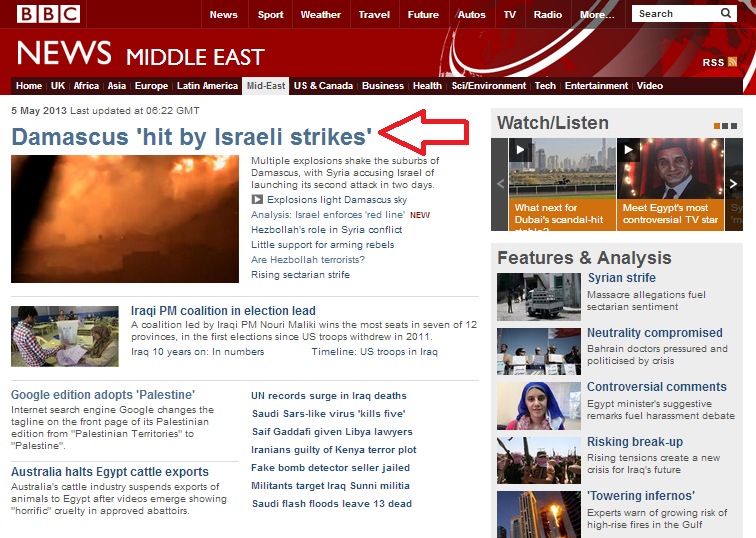
Syria 5 5
The coverage included a rolling article entitled “Damascus military facilities ‘hit by Israel rockets’” in which readers were informed that:
“The BBC’s Jim Muir in Beirut says Israel’s intervention is a very dangerous development.
He says Israel will not want to be seen as being involved in the conflict, but Syria’s state media is hammering the message that the rebels are working hand in glove with Israel.”
Apparently, any Israeli action is to be considered much more of a “dangerous development” than the possibility of long-range missiles or chemical weapons falling into the hands of a terrorist organisation. And of course that particular “message” from the Syrian authorities is nothing new – and neither is its uncritical repetition by the BBC.
That passage was later replaced by the following one:
“The BBC’s Yolande Knell in Jerusalem says the latest developments are a significant escalation in Israel’s involvement in the conflict.
She says Israel has already responded to fears of retaliation by locating two batteries of its Iron Dome missile defence system near Haifa, close to the Lebanese border.”
Haifa is, of course, some 43 kilometers from the Lebanese border. 
The latest version of that article includes a side box of analysis by Jim Muir in which he – like Yolande Knell – seems to be incapable of distinguishing between an act of self-defence and “involvement” in the Syrian civil war.
“Two air strikes in 48 hours does indeed start to look perilously like the involvement in Syria’s internal crisis the Israelis have always said they want to avoid, especially when they are visibly taking out military targets on the very edge of Damascus.” […]
“Israel has said that its only concern is to prevent advanced weapons being handed over to Hezbollah. Objectively it would be hard to see Israel’s interest in helping trigger an uncontrolled collapse of the regime, leaving the field open to rebel groups among which Islamist radicals currently make the running.”
Muir appears to be incapable of grasping the fact that beyond the issue of weapons being transferred by the Syrian regime to its allies Hizballah – a situation which would prompt further deterioration of the security situation in Lebanon and Syria as well as Israel – the very real possibility of weapons falling into the hands of those “Islamist radicals” also carries with it the potential for further destabilization of the region as a whole. 
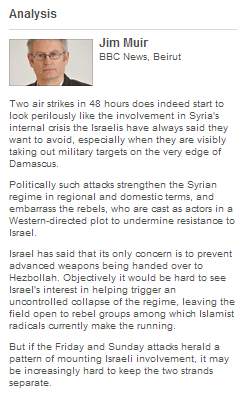
analysis Muir
The BBC’s coverage also includes an article by its Defence Correspondent Jonathan Marcus entitled “Israeli air strikes: A warning to Syria’s Assad“. Whilst all in all a balanced and informative article, in common with the BBC coverage of the strike on a weapons convoy last January, it fails to inform readers of the all-important context of UN Security Council Resolution 1701 and the international community’s utter failure to either disband Hizballah or prevent it from rearming after the 2006 war which has enabled the current situation to come about. 
Regrettably, the BBC also saw fit to resurrect a deeply flawed article from 2011 under the link titled “Are Hezbollah terrorists?” for inclusion in its coverage of these events. 
But the worst was yet to come. A later BBC report ran the headline “Israeli strikes on Syria ‘co-ordinated with terrorists‘“, yet again uncritically repeating baseless statements put out by the Assad regime.
“The Syrian foreign ministry statement said three military sites had been hit – a research centre at Jamraya, a paragliding airport in the al-Dimas area of Damascus and a site in Maysaloun.
“The flagrant Israeli attack on armed forces sites in Syria underlines the co-ordination between ‘Israel’, terrorist groups and… the al-Nusra Front,” the statement said, referring to al-Qaeda militants fighting with the rebels. […]
The statement added: “This leaves no room for doubt Israel is the beneficiary, the mover and sometime the executor of the terrorist acts which Syria is witnessing and which target it as a state and people directly or through its tools inside.” “
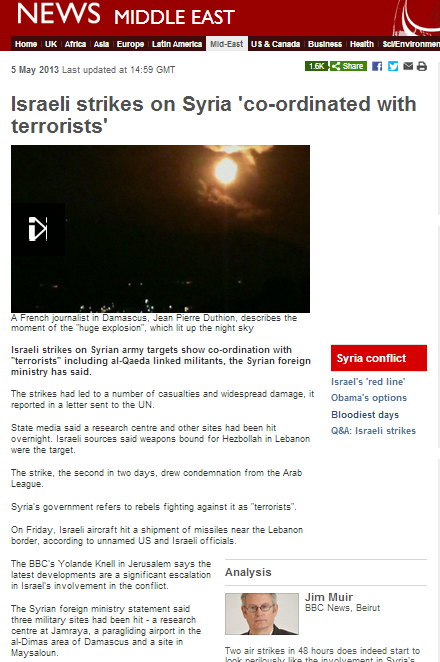
'coordinated with terrorists'

Official BBC Tweets also promoted the same propaganda.
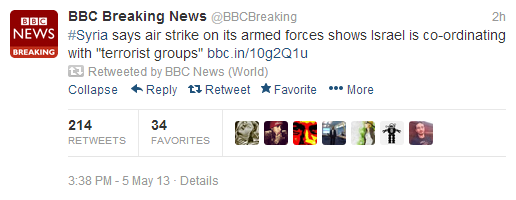
bbc world tweet
As one Tweeter succinctly put it:
tweet Maher
And no – the use of inverted commas in that headline does not excuse the unquestioned, context-free promotion of propaganda from a regime which has already killed over 70,000 of its own people. 


IDF Closes Off Airspace over Haifa

First published: 5/5/2013, 6:54 pm

passenger jet


Report:   skies over Haifa will be a no-fly zone for the next few days, due to Syria tension.


The IDF has decided to close off the air space over the northern coastal city of Haifa.

This is the second time in the last few months that the airspace over Haifa has been declared a no-fly zone due to security tensions, according to a  report in Maariv. This time, the news outlet said, it will remain closed for several days.

The decision will mostly affect passenger planes that land o rtakeoff in routes that pass over Haifa.

Syrian Deputy Foreign Minister Feisal al-Mekdad on Sunday called Israel's bombing of a weapons transport in Syria a “declaration of war.” Speaking in an interview onCNN, al-Mekdad said that Israel was siding with “Islamist terrorists” to unseat President Bashar al-Assad, and that Syria would respond “at the time and in the manner that it chooses to.”

Israel has not confirmed or denied the claims that it had attacked a convoy in Syria that was transporting Iranian produced missiles to Hizbullah over Syrian territory. “We don't respond to these kinds of reports,” an IDF spokesperson told foreign news media Sunday.


Syrian Official: Israeli Strike 'Declaration of War'. Plus a few words from Iran.


 Following Syria Strikes, IDF Moves Iron Dome to North 

The IDF has moved two Iron Dome anti-missile installations to northern Israel. The move follows media reports according to which Israel took out two weapons shipments in Syria. 

The installations were moved overnight Saturday, and have been set up in Haifa and Tzfat. 

The Iron Dome can shoot down medium and long-range missiles and rockets. It has been used with agreat degree of success to protect cities in southern and central Israel from Hamas rocket attacks. 

The move comes as Israel faces growing tension with its northern neighbors, Syria and Lebanon, over alleged airstrikes. IAF planes reportedly flew over Lebanese airspace to hit targets in Syria. 

An Israeli source confirmed Saturday that Israel had bombed “game-changing” weapons meant for Hizbullah on Friday. According to the New York Times, the IAF took out Fateh-110 missiles sent by Iran. 

If Hizbullah had Fateh-110s, it would be capable of hitting Tel Aviv. 

A second series of explosions was reported overnight in Damascus. The official Syrian news agency SANA claimed that Israel carried out an airstrike on the Jamraya research center. 

The Syrian opposition reported that the explosions hit strategic military sites. 


--


Syrian Deputy Foreign Minister Feisal Mekdad on Sunday called Israel's bombing of a weapons transport in Syria a “declaration of war"

Syrian Deputy Foreign Minister Feisal al-Mekdad on Sunday called Israel's bombing of a weapons transport in Syria a “declaration of war.” Speaking in an interview on CNN, al-Mekdad said that Israel was siding with “Islamist terrorists” to unseat President Bashar al-Assad, and that Syria would respond “at the time and in the manner that it chooses to.”


Israel has not confirmed or denied the claims that it had attacked a convoy in Syria that was transporting Iranian produced missiles to Hizbullah over Syrian territory. “We don't respond to these kinds of reports,” an IDF spokesperson told foreign news media Sunday.

Also condemning the strike was Lebanese Foreign Minister Adnan Mansour, demanding that the Arab League take “a decisive stand against Israeli terrorism.” Mansour complained that the League had remained silent “for too long” in the wake of “Israeli hooliganism,” and demanded that the League “immediately condemn the Israeli action against the Assad regime.”

British Foreign Secretary William Hague, on the other hand, expressed “understanding” for Israel's need to defend itself from terror groups. “Israel made it clear that it would respond if it suspected that advanced weapons systems were being handed over to Hizbullah,” he said. “Israel will act to defend its security,” and such actions must be “respected,” he added.


Iran Ready to 'Train' Syria Army, Says Commander


Iran is ready to help "train" the Syrian army if Damascus seeks such assistance, the commander of the Islamic republic's army ground forces, General Ahmad Reza Pourdastan, said Sunday, according to reported. 

"As a Muslim nation, we back Syria, and if there is need for training we will provide them with the training, but won't have any active involvement in the operations," he said in remarks reported by the official IRNA news agency. 

"The Syrian army has accumulated experience during years of conflict with the Zionist regime (Israel) and is able to defend itself and doesn't need foreign assistance," he added. 

His remarks came as a senior Israeli source said on Sunday that the Jewish state carried out an air strike near Damascus overnight, targeting Iranian missiles destined for Lebanon's Shiite Hizbullah movement. 

"The target was Iranian missiles which were destined for Hezbollah," he told the AFP news agency, speaking on condition of anonymity. 

Iran has remained a steadfast ally of President Bashar al-Assad's regime throughout the Syrian conflict, which according to figures released by the United Nations, has killed more than 70,000 people since it erupted in March 2011. 

source:Arutz 7


Israel is preferable Assad: Syrian refugees flock to Gaza


Read original article in Hebrew here

Hundreds of Palestinians who had fled the war in Syria forced to return to Gaza. Ode Omar, who escaped from Damascus to Egypt and then deported to Gaza under the bombs IDF maintains optimism: "Back when Assad will fall

About 500 Syrians who fled from the civil war in their country stayed in the Gaza Strip, and a third of them came to Gaza last two months. Of 500 thousand Palestinian refugees - Syrians, it seems that even the crowded Gaza Strip and closed resort seems likely, there is no solution in sight 

One of the refugees who returned to Gaza from the Yarmouk refugee camp in Damascus is Omar Oda. Oda, 56, told the British Guardian newspaper that before the outbreak of the Civil War his life was "good" and that he lived five-story building. "I was in the business of printing. Things first six months were fine., But then weakened business and the economic crisis came."

a Body) Yarmouk Palestinian refugee camp on the outskirts of Damascus 


Ode January 2012 left his family behind and left Syria to look for work. He came to Egypt but was caught without the appropriate paperwork and deported to the Gaza Strip , the record homeland. From there, Oda made ​​contact online with his wife, born and grandchildren stayed in a refugee camp in Damascus, and they told him about the horrors of war. "They saw people being killed. Grandchildren have lived with anxiety, and family begged me to send them money so they can escape."

Oda managed to raise 4,000 dollars to save his family from Syria through bribery, and bring them to live with him in Gaza. But the sense of relative security was short, because the family once again faced with the reality of a war outbreak of operation " Nube "late last year. "The family was afraid," said Oda, "but here, if I avoided dangerous places, there was a problem. Bombings were very specific. Syria, anywhere was dangerous." He said he would return to Syria when the Assad regime will fall. "I just hope it does not happen, I'm sure it will happen. I support the overthrow of Arab regimes, including Hamas and the Palestinian Authority

Protesters in front of the lodge closed UNRWA office in Gaza

Syrian refugee flow into Gaza raises concern among authorities. Issam Adwan, head of Hamas's refugees told the Guardian: "infrastructures are insufficient even for the people of Gaza. Unemployment that exceeds 30%, and refugees from Syria needed jobs and housing."

Adwan said that the UN should take responsibility for Syrians arriving to Gaza. "These are refugees Palestinians . We understand that UNRWA is a budget crunch, but it's an emergency. " UNRWA (UNRWA Palestinian refugees) said that efforts are being made ​​to find a budget for Palestinians displaced from their home twice.

Saturday, 4 May 2013

Op-Ed: Four Views on Israel's Concerns with the 1967 Lines

When working on reviving the defunct Arab Peace Initiative, why is Israel so concerned about the demand to return to 1967 lines?


- Amb. Alan Baker

With ongoing and increasing intensity, the Palestinian leadership is fixated on advancing a concerted policy vis-à-vis the international community and public opinion, demanding recognition of what they claim to be the "1967 borders," and acceptance of a unilaterally declared Palestinian state within those borders. There are no provisions in any of the agreements signed between Israel and the Palestinians that require withdrawal to the "1967 borders." There were never any geographic imperatives that sanctify the 1967 lines.(Jerusalem Center for Public Affairs)


- Amb. Dore Gold

Several months after Israel captured the West Bank and Gaza in the 1967 Six-Day War, the UN Security Councildefined the territorial terms of a future peace settlement in Resolution 242, which over the decades became the cornerstone for all Arab-Israeli diplomacy. Resolution 242 made clear that Israel was not expected to withdraw from all the territories that came into its possession, meaning that Israel was not required to withdraw from 100 percent of the West Bank. Moreover, neither Resolution 242 nor any subsequent signed agreements with the Palestinians stipulated that Israel would have to pay for any West Bank land it would retain by handing over its own sovereign land in exchange. (Weekly Standard)
- Amb. Dore Gold


Israel's greatest strategic minds have long opposed the 1967 lines.(Los Angeles Times)
- Dr. Joshua Teitelbaum

While several aspects of the Arab Peace Initiative represent significant and positive developments in the official, collective Arab view of the future of Israel in the Middle East, Israel should refrain from accepting the initiative as a basis for peace negotiations because it contains seriously objectionable elements.(Jerusalem Center for Public Affairs)


http://www.israelnationalnews.com/

Thursday, 2 May 2013

Al-Qaeda’s Branch in Gaza Set to Escalate Anti-Israeli Terror

The “Mujahideen Shura Council in the Environs of Jerusalem” has taken responsibility for a series of missile firings at Israeli targets from Gaza and Sinai, which is under Egyptian sovereignty, including:
  • 17 April 2013 – Firing of two Grad missiles at Eilat from Sinai.
  • 3 April 2013 – Firing six missiles at Sderot from Gaza.
  • 2 April 2013 – Firing three missiles at the Kissufim military base and two missiles at the Nir Oz community from Gaza.
  • 21 March 2013 (during President Obama’s visit to Israel) – Firing a number of missiles at Sderot from Gaza.
The Shura Council is ideologically identified with al-Qaeda, including its goals and forms of activity, and the organization views “political Islam,” as represented by the Muslim Brotherhood and Hamas, as a deviation from the path of proper Islam.
Relations between the Hamas regime in Gaza and this extreme Salafi organization have had their ups and downs over the past six years since Hamas seized control in Gaza. The Shura Council, like other Palestinian terror organizations ideologically identified with al-Qaeda, has not been outlawed. But when the organization’s activities have harmed the interests of the Hamas regime or challenged its rule, Hamas has cracked down with violent suppression, arrests, and torture.
Hamas’ current strategy focuses on strengthening the status of the government in Gaza as the legitimate representative of the Palestinian people, on opening channels of dialogue with European states, on fortifying Hamas’ rule including from an economic standpoint, and on building up its military capabilities for the day of reckoning in the near future.
Hamas’ policy on terror from Gaza is subordinate, then, to certain considerations, including: keeping terror from Gaza on a low flame for the time being (so long as there is no direct, frontal clash with Israel), using other organizations as surrogates for terror, using Hamas forces for belligerent acts only within the territory of Gaza, and imposing – violently when necessary – the rules of the game on all organizations operating in Gaza.
The Shura Council totally dismisses the Hamas regime’s “political” considerations in implementing its jihad policy. Aware, though, of the regime’s power with its base in the Al-Qassem Brigades, the council strives to play by the rules while sometimes testing the limits with acts that create tension with Hamas.
The Arab Spring – or more accurately, Islamic winter – that has swept the Middle East has bolstered the status of the Hamas government, which is getting support and aid from the new regimes brought to power by the popular revolutions that were led by the Muslim Brotherhood, the parent movement of Hamas.
Along with the rise of the Brotherhood, however, the power of the Salafi Islamist organizations has also grown, giving them a sense of a historic moment of opportunity in which the Islamic Revolution in its al-Qaeda version can be advanced on the way to reestablishing the Islamic Caliphate.
This sense of power, which is also drawn from the successes of Jahbat al-Nusra, the Syrian rebel organization identified with al-Qaeda, and other Islamic rebel organizations in Syria, has led the Shura Council in Gaza to consider ways of extending its activities in the realm of jihadand further winning sympathy among the Palestinian population.
Sheikh Abu Bilal al-Shami, a member of the Sharia Committee of the Shura Council, recently published a document that presents the organization’s current strategy, which is attuned to the new circumstances and opportunities facing Salafi Islam in the wake of the Islamic revolts.
An analysis of the document reveals the following main features of the Shura Council’s policy:
  • To regard the Hamas regime as a rival and enemy that seeks to undermine the jihad out of foreign and invalid considerations.
  • To seek an uncompromising struggle against democracy (including the Hamas version), nationalism, communism, and Shiism.
  • To exploit the atmosphere in the new Middle East to provoke the masses in Gaza and the neighboring countries to support the path of “jihadi Salafism,” and to demand that Hamas stop persecuting its activists on the pretext of maintaining the truce with Israel.
  • To opening additional jihad fronts against Israel from the territory of Syria, Jordan, Lebanon, and Egypt based on the new circumstances, geographic features, and populations.
  • To escalate jihad activities in every way, whether through missile firings, suicide attacks, electronic warfare, and the like, with no connection to the policy of Hamas.
  • To damage Israel’s economy both through military attacks and cyber attacks.
  • To strengthen the links between the mujahideen in Gaza and those active in other parts of the world so as to create worldwide jihad organizations
  • To try to persuade the Islamic actors to support and financially assist the Salafi jihadielements instead of Hamas
  • To unify all the mujahideen forces in Gaza under the aegis of the Shura Council.
  • To develop a dawa (proselytizing) capability and adopting a pro-jihad dawa program in Gaza aimed at inculcating the Salafi ideological platform among the society as a source of strength for the organization.
  • To try to get Hamas activists to desert to “jihadi Salafism,” with an emphasis on the duty of the Muslim to be loyal to Allah alone, and portraying loyalty to a party as a form of jahiliyya(pre-Islamic ignorance).

Lt. Col. (ret.) Jonathan D. Halevi

http://jcpa.org/al-qaedas-branch-in-gaza-set-to-escalate-anti-israeli-terror/


Wednesday, 1 May 2013

Glenn Greenwald on the sage foreign policy wisdom of the ‘Underwear Bomber’


Glenn Greenwald’s response to the terrorist attack in Boston should come as no surprise to those familiar with his ‘Comment is Free’ blog, and his previous blog at Salon.com.
In addition to smearing as ‘Islamophobic’ anyone who suggested, in the early hours and days of the investigation into the attack which left 3 dead and over 200 injured, that the culprits may be Islamists, his reaction once it seemed clear that the terrorists were radicalized Chechnyan Muslims was to argue, in a fashion similar to Richard Falk, that such attacks should ‘inspire’ us to reflect on US policy in the Mid-East.
Greenwald’s April 24 post at ‘Comment is Free’, entitled ‘The same motive cited for anti-US terrorism is cited over and over‘, provides another good example of such reasoning.
Greenwald writes thusly:
In the last several years, there have been four other serious attempted or successful attacks on US soil by Muslims, and in every case, they emphatically all say the same thing: that they were motivated by the continuous, horrific violence brought by the US and its allies to the Muslim world – violence which routinely kills and oppresses innocent men, women and children.
He then quotes the complaints against US foreign policy expressed by several convicted Islamist terrorists, such as Faisal Shahzad, the Pakistani-American convicted of an attempted bombing attack at Times Square in 2010, Nidal Hasan, who will soon stand trial in a military court for the Fort Hood massacre, as well as the attempted “Underwear Bomber” Umar Farouk Abdulmutallab.
bomberGreenwald cites the following grievances of Abdulmutallab, which he expressed in a US court before pleading guilty of trying to murder hundreds of people on board Northwest Airlines Flight 253 on Christmas Day in 2009:
I had an agreement with at least one person to attack the United States in retaliation for US support of Israel and in retaliation of the killing of innocent and civilian Muslim populations in Palestine, especially in the blockade of Gaza, and in retaliation for the killing of innocent and civilian Muslim populations in Yemen, Iraq, Somalia, Afghanistan and beyond, most of them women, children, and noncombatants.”
Greenwald, while making it clear that violence is still not justified, added the following:
But it is nonetheless vital to understand why there are so many people who want to attack the US as opposed to, say, Peru, or South Africa, or Brazil, or Mexico, or Japan, or Portugal.
…
…so many Americans, westerners, Christians and Jews love to run around insisting that the only real cause for Muslim attacks on the US is that the attackers have this primitive, brutal, savage, uncivilized religion (Islam) that makes them do it.
…
As the attackers themselves make as clear as they can, it’s not religious fanaticism but rather political grievance that motivates these attacks. Religious conviction may make them more willing to fight (as it does for many in the west), but the motive is anger over what is being done by the US and its allies to Muslims.
…
it’s crucial to understand this causation because it’s often asked “what can we do to stop Terrorism?” The answer is right in front of our faces: we could stop embracing the polices in that part of the world which fuel anti-American hatred and trigger the desire for vengeance and return violence.
However, to add some context to Greenwald’s explanation of ‘why they hate us’, here’s a relevant passage from the court transcript at Abdulmutallab’s sentencing.
Defendant poses a significant, ongoing threat to the safety of American citizens everywhere. As noted previously, in pleading guilty, defendant reiterated that it is his religious belief that the Koran obliges “every able Muslim to participate in jihad and fight in the way of Allah, those who fight you, and kill them wherever you find them,” and that “participation in jihad against the United States is considered among the most virtuous of deeds in Islam and is highly encouraged in the Koran.”
The court sentencing document continues to explain what inspired him to jihad:
In August 2009, defendant left Dubai, where he had been taking graduate classes, and traveled to Yemen. For several years, defendant had been following the online teachings of Anwar Awlaki, and he went to Yemen to try to meet him in order to discuss the possibility of becoming involved in jihad.
Anwar Awlaki was the American and Yemeni Imam, killed in a US drone strike in 2011, who U.S. government officials believe was an al-Qaeda regional commander, and a senior ‘talent recruiter’ and motivator for the terrorist group – and who is believed to have influenced the jihadist rampage of the Fort Hood shooter.
Here’s an additional passage from Abdulmutallab’s sentencing:
Defendant by that time had become committed in his own mind to carrying out an act of jihad, and was contemplating “martyrdom;” i.e.

, a suicide operation in which he and others would be killed. Once in Yemen, defendant visited mosques and asked people he met if they knew how he could meet Awlaki.
…
Thereafter, defendant received a text message from Awlaki telling defendant to call him, which defendant did.
…
Defendant took several days to write his message to Awlaki, telling him of his desire to become involved in jihad, and seeking Awlaki’s guidance. After receiving defendant’s message, Awlaki sent defendant a response, telling him that Awlaki would find a way for defendant to become involved in jihad.
So, in short, the ‘Underwear Bomber’ sought out the advice of a senior leader of an Islamist movement which calls for global jihad, seeks states governed by religious autocracies similar to the Taliban in Afghanistan, advocates death for homosexuality, and believes Jews are the embodiment of evil.
The suggestion that we should listen to the foreign policy ‘analysis’ of such homicidal jihadists is akin to imputing wisdom to the suicidal rants of conspiracists and radical cults – as if we should see the “revolutionary mass suicide” initiated by Jim Jones as a learning moment about the need for “social justice”, or that the US should incorporate the militia movement-inspired complaints of Timothy McVeigh into federal policy.
The ideological proclivity of some on the far-left to empathize with those, like Abdulmutallab, who willfully embrace the most violent, reactionary and racist movements in the world represents a dynamic as dangerous as it is baffling.
http://cifwatch.com/
