Showing posts with label PA terror atack. Show all posts

Wednesday, 4 December 2013

BBC explains why it did not report on toddler injured by stone-throwers


Typical of the BBC a arab terror attack on Israelis is not reported.  But.... Israel Gov. just think to build A Jewish Home....BBC reporters are the first ones to shout & complain.
On Sunday December 1st two year-old Avigail Ben Zion was released from hospital in Jerusalem where she had been treated for the fractured skull she sustained in the stone-throwing attack on her mother’s car the previous week. 
As was noted here at the time, that incident – like many other non-fatal attacks on Israelis – was not reported by the BBC, despite its having an office eleven minutes away from the site of the attack in south Jerusalem.


A reader who contacted the BBC regarding that failure to report the attack on a woman and three small children received the following reply:
“We do not report every incident in the conflict between Israel and the Palestinians. This does not in any way mean that we judge the attack which injured the toddler as not serious important [sic], but we cannot report every case where there is a casualty.  Naturally the story received coverage in Israeli media as one would expect, but this does necessarily mean we would report it too.”
The writer of that reply – and apparently the BBC in general – clearly does not grasp that the issue here is not one of how the BBC chooses to “judge” the seriousness or importance of an incident.  Such unsolicited judgement is neither necessary nor relevant to anything except the BBC’s own sense of self-importance.
What is relevant, however, is that the BBC is obliged under the terms of its charter – its constitutional basis – to fulfil the public purpose of informing and providing context to audiences in order to enable them to form informed opinions on “international issues”.
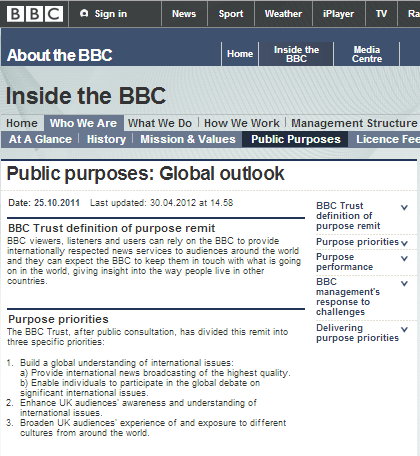
Public Purposes
One such international issue is the talks currently going on between Israel and the PLO in the framework of the search for a peaceful solution to the Arab-Israeli conflict. It is a subject which the BBC has covered extensively, producing numerous reports and backgrounders on the subject.
The issue of the rising scale of terror attacks against Israeli civilians even as those talks continue is, however, one which has been largely ignored or downplayed by the BBC. That means that its audiences have no appreciation of the influence of those quotidian attacks (especially those in which children are injured) on Israeli public opinion regarding the issue of the ‘peace process’ and are deprived of the context necessary to understand Israeli policy and actions – as they were, for example, at the beginning of Operation Pillar of Cloud in November 2012 because the BBC had previously under-reported the missile attacks on Israeli civilians living in proximity to the Gaza Strip.
Hence, the relevance of the BBC’s decision not to report on a terror attack against a toddler and her family at rush hour in Israel’s capital city is not to be found in the BBC’s assessment of that incident’s ‘seriousness’ or ‘importance’, but in the fact that by not reporting it, the BBC is failing to meet the obligations to inform audiences which are its very raison d’etre. 

Thursday, 28 November 2013

Op-Ed: Israel's Press: Read the 'Jenin Times'


An Israeli journalist responds to the NY Times posting of a picture of the mother of the killer of a young IDF soldier instead of a picture of the victim, a teenager stabbed while dozing on a public bus. Jenin is a city in the PA.


The New York Times has been outdoing Haaretzlately in the race for the title of most hated newspaper in Israel. Most Israelis have never actually read The Times in the original English, but the little that has been translated into Hebrew is enoguh to infuriate them,  and despite the newspaper's longstanding reputation, they do not believe anything it prints.

The paper's columnists' Israel-bashing, on almost every topic and on just  about every  issue, is notorious in Israel and has reduced the popular opinion of  its objectivity to the level of the average Israeli's belief in the activities of the UN Human Rights Commission. Can't get lower than that.

Thomas Friedman is beginning to be perceived here in Israel as an English version of Gideon Levy (an super-radical leftist Haaretz columnist, abhorred by most Israelis) and the paper's editorials about Iran are seen as messages received directly from the White House.

Recent days saw a new cause for anger - an infuriating report on the paper's website of the young IDF soldier's murder in Afula last week, witnessed by an entire busload of people. Instead of posting a picture of the murdered stabbing victijm (a stabbing victim, that is, 'according to the police', the paper carefully hedged) the editors preferred to place a picture of the murderer's mother to illustrate the article's headline.  She looked proud despite her "suffering", surrounded by worried acquaintances, managing to convey the impression that she is the real victim of the lethal act perpetrated by her son.

"Every newspaper has its heroes" was the way I described it at the beginning of the week as I began writing this column. But several days ago, The Times apologized. The newspaper's ombudsman wrote that after waves of criticism were received from readers "I spoke with two senior editors and both agreed that the choice of picture was unfortunate."

The blame was passed on to an assistant to the chief editor responsible for photographs, who reportedly claimed that she was trying to reach a "proper balance' in the reporting and didn't realize that "this effort is not suitable for the incident at hand".

In other words, the assistant editor overdid her attempts to be balanced, in her way of trying to continue the longstanding tradition of the New York Times to strike a balance between the murdered and the murderers. Most of the time this effort is somewhat concealed, hidden tastefully among thousands of whitewashed words. This time there was a work accident.

The Times was caught red-handed.


source  
Haggai Segal

Wednesday, 13 November 2013

Likud hardliners call to stop peace talks after suspected terror attack

Danon says Israel must stop release of Palestinian prisoners after IDF soldier killed in Afula attack; Hotovely: PA incitement to blame; Bayit Yehudi's Yogev: IDF must do more to stop Palestinians from illegally entering Israel.


Lawmakers in Prime Minister Binyamin Netanyahu's party called for him to stop peace talks after a Palestinian teen stabbed a soldier near Afula Wednesday.
"The talks are deluding both the Israeli public and the Arabs," Deputy Defense Minister Danny Danon said. "We must stop this predictable crash course immediately."
"[PA President] Mahmoud Abbas has a tactic of indirectly harming Israel. Jews aren't killed by PA officials but by the 'Palestinian street,' which is fed each day by anti-Israel propaganda. We cannot continue talking peace while the PA is talking terror," Hotovely added.Danon also called to stop the release of Palestinian prisoners.

Deputy Transportation Minister Tzipi Hotovely said "the Palestinian Authority's well-oiled incitement system continues to claim victims."

Meanwhile, opposition leader Shelly Yacimovich said she trusts the IDF in its fight against terror and called on Netanyahu not to use the attack "to continue sabotaging negotiations, which anyway are bruised and battered taking place under the shadow of a crisis with the US."
Bayit Yehudi MKs also spoke out against concessions in negotiations, with Knesset Finance Committee chairman Nissan Slomiansky saying the stabbing "is a direct result of Israel's policy of freeing terrorists."
"We make difficult concessions for which we pay in human lives, while the Palestinians only talk," he stated. "The current situation endangers our sons and daughters while the PA celebrates the release of murderers. This is intolerable and must stop immediately."
MK Motti Yogev (Bayit Yehudi) said the attack was a result of the IDF not doing enough to stop Palestinians from illegally entering Israel.
"When PA incitement teaches hatred of Jews and calls to destroy us...our security forces must enforce the law and realize that they can prevent the next murder," he remarked.
Almagor Terror Victims Organization chairman Meir Indor said "we cannot ignore what is behind the recent chain of terror attacks. It is encouraged by the American government, which threatens the obedient Israeli government if they do not release terrorists."
"The lives of Jews are not as important to [US Secretary of State] John Kerry as the residents of Boston. He wouldn't have released the Chechen terrorist," Indor added, in reference to Dzhokhar Tsarnaev, the suspected Boston Marathon bomber.
Jerusalem post 

Wednesday, 30 October 2013

BBC continues to ignore non-fatal terror attacks


On the morning of Friday, October 25th a vehicle transporting pupils from Mevo Dotan in northern Samaria to school was attacked with an improvised explosive device. Fortunately, neither the driver nor the young passengers were injured. IDF forces searched the area for the perpetrators of the attack. 
On the evening of Saturday, October 26th a bus and a car travelling in the al Fawar area south of Hebron were attacked by stone-throwers. Eight Israelis and one Palestinian girl were injured in the attacks.
In the early afternoon of October 27th two mortars fired from the Gaza Strip hit the Eshkol region of the western Negev, fortunately falling in open areas with no injuries caused.
Like the vast majority of attacks against Israeli civilians, none of these examples of recent attacks was reported by the BBC, which tends only to relate to incidents in which there are fatalities or to Israeli actions resulting from those attacks. 
Terror, of course, is not just about specific incidents of damage, death and injury – its main purpose is the ‘drip drip’ intimidation of the broader civilian population with the knowledge that it could happen to them too – at any time and in any place – and the use of that fear to force political concessions from governments ultimately steered by public opinion.
Whilst many informed observers currently do not seem to regard the recent upsurge in violence as heralding an imminent third intifada, the fact remains that by downplaying – or completely ignoring – the daily acts of violence directed at Israeli civilians, the BBC neglects to provide vital context which is crucial for audience understanding of the situation as a whole and specifically, Israeli counter-terrorism measures aimed at containing the violent incidents targeting civilians. 
But the failure to accurately report the overall picture does not only sell short the BBC’s obligation to provide audiences with a “global understanding of international issues“; it also affects the standard of BBC reporting and adherence to its own editorial guidelines on accuracy and impartiality. 
As we saw in the lead up to last year’s ‘Operation Pillar of Cloud’, the fact that the BBC had consistently ignored the majority of the preceding missile fire and other attacks (putting no reporter on the ground in towns and cities such as Ashkelon and Netivot until Israel responded to six weeks of paralysing missile attacks) meant that – with BBC audiences oblivious of the context – it was then able to erroneously claim that the violence began with Israel’s targeting of Ahmed Jabari and to make the bizarre assertion that the operation was part of the incumbent Israeli government’s election campaign.  
It is the same lack of presentation of the context of the ‘drip drip’ of ongoing intimidation by terror which creates an environment in which BBC presenters can embarrass themselves – and the organization they represent – by making crass statements about the numbers of Israeli casualties, as was the case with Mishal Husain last year.
Clearly, an organisation as experienced in news reporting as the BBC can do better – both for its audiences and for its own reputation – if it so wishes. 

Sunday, 27 October 2013

Two Mortar Shells Hit Southern Israel Attacks from Gaza continue: two mortar shells hit Eshkol region in southern Israel.


Gaza terrorists fired two mortar shells at the southern Negev early on Sunday afternoon. The shells exploded in the Eshkol region, but did not cause injury.

The military has advised agricultural workers in the area to seek shelter.

Last week terrorists from Hamas-controlled Gaza fired a mortar shell that hit the Eshkol region. Less than a week earlier, a projectile fired from Gaza hit southern Israel.

Recently, Hamas’ “military wing” has admitted to being behind an attempted attack involving a “terror tunnel” leading from Gaza to an Israeli kibbutz. The group admitted that the tunnel was to be used to kidnap Israeli soldiers.

Israel suspended the transfer of construction supplies to Gaza through Israeli territory in response to the discovery of the tunnel.


Mortar attacks have increasingly become an issue on Israel’s northern border, as well, where projectiles have crossed the border as fighting rages in Syria’s civil war. In early October two IDF soldiers were wounded by cross-border mortar shell fire.

Arutz Sheva

Saturday, 26 October 2013

Israeli Terror Victim Harassed by Cyber-Stalker


In December 2010, Kay Wilson found herself in the midst of a nightmare when she and visiting American Christian friend Kristine Luken were attacked by knife-wielding Palestinian Arabs in a forested area south of Jerusalem.

Wilson previously recounted for Israel Today the traumatic event that took her friend's life and left her badly wounded.
But Wilson's pain and suffering was long from over. In addition to dealing with medical treatments, rehabilitation, emotional scars, and a struggle to receive the insurance coverage due a victim of terror, Wilson was also targeted relentlessly by an Internet stalker determined to smear her name.
For over two years, the stalker used private Facebook accounts and the comment sections of any news website that dared to write about Wilson's plight to promote his own, twisted version of events.
According to this individual, Wilson's injuries were only superficial (a fact easily disproved by her own medical records) and she was just trying to milk the state for money. But far worse than the accusation of fraud was his claim that Wilson was the one who had murdered Luken.
Nearly all of the stalker's assertions were quickly debunked when Israeli police announced the arrest and confession of the two Palestinian assailants in 2011, but that didn't stop him from endlessly harassing Wilson.
Finally having had enough, and armed with a strong suspicion of whom she was dealing with, Wilson engaged the services of a private investigator who quickly compiled evidence on the perpetrator.
In September of this year, Wilson gave the stalker an opportunity to make matters right privately, but threatened to go public should he fail to respond.
Among Wilson's demands were that the stalker remove all slanderous claims from the Internet, issue a public apology, and reimburse her for the cost of the private investigator.
When these conditions were not met, Wilson made public the identity of her tormentor, one Jon Selby. She told Israel Today that legal proceedings against Selby are forthcoming, and added:
"In all good faith I can not call the person who did this to me a 'man.' His attempted character assassination of myself is in some ways as cowardly and as odious as the Palestinian terror attack. Jonathan Selby is also a terrorist. An emotional terrorist. Just like the terrorists, Selby attacked the defenseless: Just like the terrorists he executed his heinous deeds in secret, thinking that he would never be caught: And just like the terrorists, Israeli justice will serve it's cause."

Wednesday, 23 October 2013

Independent’s coverage of Palestinian terror again highlights perpetrator’s family


Last Thursday, Oct. 17, a Palestinian named Younes al-Radaideh, from Beit Hanina, rammed a tractor he was driving into an IDF base north of Jerusalem in an attempted terror attack. He succeeded in breaking through the fence and rammed into buildings and several vehicles, injuring one Israeli, before being shot and killed by two soldiers.
Reports indicate that Younes al-Radaideh is the brother of Marei al-Radaideh, the man who carried out another terror attack involving a tractor in March, 2009, in Jerusalem.
The Independent’s coverage of this latest terror incident consisted of the following photo (and accompanying caption) in a photo story titled ‘Pictures of the day: West Bank simmers as Palestinian anger builds in face of occupation’.
indy
The caption reads: 
A relative shows a picture of Palestinian Yunes Ahmed al-Radaydeh, the construction worker who was shot dead after forcing his way into a West Bank army base.
In addition to the misleading nature of the caption – which seriously downplayed the potentially lethal attack – the Indy’s decision to highlight the family of the perpetrator mirrors their use of photos in a story on July 28 about Israel’s decision to release 104 Palestinian ‘pre-Oslo’ prisoners – a group largely consisting of terrorists who murdered or attempted to murder Israeli citizens.
Here’s the July 28 caption:
The mother of Palestinian Ateya Abu Moussa, who has been held prisoner by Israel for 20 years, hugs her grandson upon hearing the news that her son may soon be released
Additionally, when the first 26 Palestinian prisoners – out of the larger group of 104 – were released the following month (a group which included Ateya Abu Moussa), the Indy covered the story with another photo series depicting the reaction of Palestinian family members.  Here’s the photo they used to illustrate Ateya Abu Moussa’s release:
moussa
The caption reads:
Freed Palestinian prisoner Ateya Abu Moussa (3rd R), who was held by Israel for 20 years, hugs his father upon arriving at his family’s house in Khan Younis in the southern Gaza Strip
The Indy evidently didn’t deem it worthy to note that Ateya Abu Moussa had been imprisoned for murdering an Israeli Holocaust survivor named Isaac Rotenberg in 1994.
Whilst, fortunately, no Israelis were killed in the terror incident on Thursday, the decision by Indy editors to again highlight the attacker’s family represents another example of the moral inversion continually on display in British media coverage of Palestinians who attempt to murder Israeli citizens.

Tuesday, 8 October 2013

Is the Guardian unmoved by the recent terror attack on a 9-year-old Israeli girl?


As most mainstream media news sites and wire services have reported, a 9-year-old girl named Noam Glick was shot Saturday night in Psagot – an Israeli town located north of Jerusalem, adjacent to Ramallah, al-Bireh, and Kokhav Ya’akov - in a likely Palestinian terror attack.
Noam had stumbled upon a man, believed to be a Palestinian terrorist, as he was about to break into her home. He shot her from a very close distance and then fled the scene. The girl was apparently saved because the bullet that hit her in the neck didn’t move two centimeters to the left or the right, her father, Yisrael Glick, told reporters.
According to her father’s account, per the Jerusalem Post
Around 9:20 p.m. on Saturday night Noam returned home from a Bnei Akiva event. She walked by her front yard, which was littered with bicycles and a tricycle. As she started to descend the outside back stairwell, she saw a figure on the bottom landing with a masked face and eyes that peered out into the darkness, her father said.
“At first it went through her head that maybe this was a guest, but then she understood that it was not,” Glick said.
Based on his daughter’s description, Glick said, the man saw Noam, stood a meter away, aimed his gun and fired three shots.
Noam later told her father, “Abba [father] he aimed a gun at me and then there were three [explosions], bomb, bomb, bomb.”
Then she yelled, “‘Save me!’ as loud as she could,” Glick said. He added that he believes her scream scared the man and caused him to flee.
IDF soldiers are still searching for the terrorist who they believe fled to the nearby Palestinian town of El Bireh.
Thus far, the Guardian has not devoted any coverage to the attack on Noam.
Their dearth of coverage regarding the attempted murder of a little Israeli girl stands in contrast to their coverage, in July, of a 5-year-old Palestinian boy who was briefly detained by Israeli troops afterthrowing rocks at cars near Hebron. Here’s a snapshot of the Guardian video report on the incident:
five
Guardian, July 12

The father of the Palestinian boy was briefly questioned and then the two were both released.
The Israeli girl remains hospitalized at Jerusalem’s Shaare Zedek Medical Center following surgery which was performed on Saturday night. 

F131005FFF02-477x318
Noam Glick enters a Jerusalem hospital after being shot by a terrorist on Saturday night.

Kerry’s Peace Process Exploding


On Saturday night a Palestinian terrorist snuck into the Israeli community of Psagot, north of Jerusalem and near Ramallah, and either shot or stabbed a nine-year-old girl, Noam Glick. Noam was rushed to hospital in Jerusalem and, fortunately, is in stable condition.


660x390photo_1374041930808-1-0

The terrorist, however, melted back into the Palestinian population and has not yet been apprehended, and the attack was part of a pattern
.In the Jewish year that ended on the Rosh Hashanah holiday on September 4, a single Israeli was killed in a Palestinian terror attack, though there were scores of potentially lethal rock- and firebomb-throwing incidents and kidnapping attempts, as well as some thwarted suicide bombings.
In the new year, however, two Israelis have already been killed by Palestinian terror: 20-year-old Sgt. Tomer Hazan on September 20 and 20-year-old St.-Sgt. Maj. Gal (Gabriel) Kobi on September 22.
While Hazan’s killer was quickly apprehended, the sniper whose bullet killed Kobi is yet to be found.
Meanwhile it was reported on Friday that terror attacks of all kinds rose “dramatically” in September, with a total of 133 (including, again, large numbers of rock- and firebomb-throwing incidents) compared to 68 in August.
It was last July 29 that the new round of ostensible Israeli-Palestinian peace talks was launched in Washington. It took months of heavy pressure on both sides by the new secretary of state, John Kerry, to reach that outcome.
The clincher was U.S. and Israeli acquiescence to the demand of Palestinian Authority president Mahmoud Abbas that the talks be accompanied by Israel’s phased release of 104 “pre-Oslo” (pre-1993) terrorists, including convicted murderers of men, women, and children. The first batch of 26 were released on August 13.
The justification given for the talks, and for the large-scale freeing of murderers, was that the talks would “calm the Palestinian arena” and possibly lead to peace in nine months, the time span that Kerry determined for them from the outset.
If it’s clear by now that the Palestinian arena has not been calmed (let alone making peace preparations), it’s not the first time that talks have in fact prompted a spike in terror.
The original “Oslo” talks in 1993 were followed by almost three years of Palestinian terror attacks that killed hundreds of Israelis. The 2000 Camp David talks were followed by the even more lethal five-year Second Intifada, which killed about a thousand.
There are indications, too, that the current round of talks has been causative of the new terror wave.
Two weeks ago Palestinian-affairs expert Khaled Abu Toameh reported that “a connection seems to exist” between the two phenomena, with Palestinian groups—including the armed wing of Abbas’s own Fatah movement—vowing to escalate terror and stop the talks. It was already known that all the Palestinian organizations, from the Islamist Hamas to the relatively secular Fatah itself, fiercely opposed the negotiations.
Saturday night’s attack in Psagot sparked demands from right-of-center cabinet ministers and Members of Knesset that the talks be halted. Energy and Water Minister Silvan Shalom claimed Israel would reconsider further prisoner releases.
With Israel facing strategic threats, particularly from Iran to the east but also from the Syrian imbroglio and from Hizballah to the north, Prime Minister Binyamin Netanyahu wants to get along with Washington as well as possible and will not easily take such steps. Israel, having entered the talks, may also be in a damned-if-we-do, damned-if-we-don’t position, with 58% of Palestinians predicting a Third Intifada if the talks “fail.”
For now, though, some points should be kept in mind:
● Although cooperation between Israeli and PA security forces—against a common foe, Hamas—has been vaunted as an achievement and promising sign, there has been no indication of any cooperation whatsoever by PA security forces in locating the murderer of Gal Kobi or the attacker of Noam Glick. Palestinian society has long regarded such individuals as heroes.
● Nor has there been any condemnation of these acts by PA officials. Only once, speaking in English to a small group in New York, was Abbas pressed into making a reluctant, equivocal noncondemnation.
● As Netanyahu emphasized in Sunday’s cabinet meeting, “the Palestinian media continues to promote incitement” and “the Palestinian Authority cannot wash its hands of it.” The latest example: Fatah’s Facebook pagepraised the shooter of the nine-year-old girl, combining him with Gal Kobi’s killer into a single mythic figure called “the sniper of Palestine.”
● Finally, in his speech to the UN on September 24, President Obama said that:
In the near term, America’s diplomatic efforts will focus on two particular issues: Iran’s pursuit of nuclear weapons, and the Arab-Israeli conflict. While these issues are not the cause of all the region’s problems, they have been a major source of instability for far too long, and resolving them can help serve as a foundation for a broader peace.
In reality, the “Arab-Israeli conflict” is now on the back burner, and Sunni Arab states mainly see Israel as a tacit ally against Iran. As for the Palestinian dimension of that conflict, it is not clear how many dead and wounded there will have to be until it is understood that, so long as the Palestinians view Israel as the incarnation of evil, prodding them toward “peace” only makes matters worse.

Nine-Year-Old Girl Shot in Terror Attack


Monday, 7 October 2013

Father Says 9-Year-Old Girl's Scream As Terrorist Attacked Prevented A Slaughter


Father of Shooting Victim: Noam's Scream Saved Us
On Saturday night, a terrorist entered the community of Psagot, north of Jerusalem, and shot nine-year-old Noam Glick in the neck at close range. The girl was badly injured, but is in good condition after surgery.

According to her father Yisrael, if it had not been for Noam's quick response, the attack could have ended in the entire family's murder.

"It's the most frightening thing that can happen to a family - that a terrorist enters the family home," he told IDF Radio (Galei Tzahal). "The terrorist basically was startled by Noam and, instead of entering the house, shot her... Her scream saved us from disaster."

Noam was conscious after the shooting and was able to tell her parents that a man with his face covered had entered the yard and had shot her. She was taken to a Jerusalem hospital for treatment.
IDF soldiers hunted for the terrorist overnight, but without success. The manhunt continues as of Sunday morning.

Soldiers discovered a break in the security fence constructed by the Defense Ministry around Psagot, which is located near the Arab town of El-Bireh that adjoins Ramallah. They also found a makeshift weapon which may be the gun that was used in the attack.

Arutz Sheva