Showing posts with label elections. Show all posts

Thursday, 24 October 2013

Accuracy and impartiality failures in BBC report on Jerusalem elections


On October 20th we noted here that the BBC has failed to report on the intimidation of potential candidates and voters in the upcoming Jerusalem municipal elections by Palestinian political groups.
On October 21st a feature on the subject of the Jerusalem municipal elections titled “Jerusalem: Communities up-close” by Erica Chernofsky appeared on the BBC News website’s homepage and on its Middle East page.
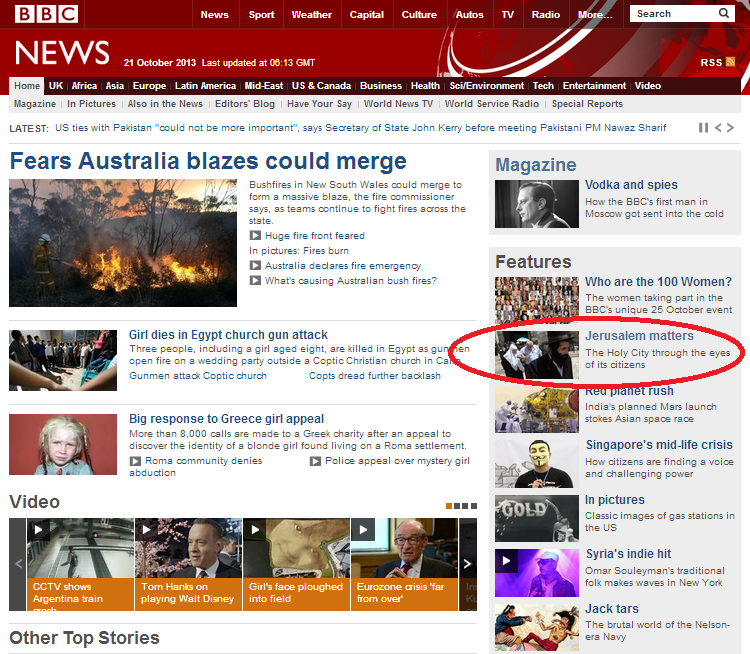
hp Jerusalem
ME pge Jerusalem
The article opens:
“Jerusalemites are preparing to cast their vote – or abstain in protest – in municipal elections. The city is home to the world’s major religions and a host of social, political and economic issues. Here, the BBC’s Erica Chernofsky looks at some of Jerusalem’s diverse communities and the matters which concern them.”
Moving quickly on from Chernofsky’s poetic descriptions of the city, the article gives an early presentation of the standard BBC mantras:
“Despite its charm, Jerusalem is also a source of bitter disputes. It is a divided city, part Arab, part Jewish, and its ownership is still fought over, as ever.
Both Israel and the Palestinians claim it as the capital of their nations. Israel captured East Jerusalem in the 1967 war and later annexed it, but the international community does not recognise this sovereignty.”
As ever, the BBC presents history as beginning in June 1967, with no proper background provided either about the 19-year Jordanian occupation of Jerusalem which divided the city for the first and last time in its history, the expulsion of Jews from neighbourhoods now described as “Arab”, or the background to the Six Day War itself.
Equally predictable is the BBC’s failure to inform audiences that the original PLO Charter of 1964specifically renounced any territorial claims to areas occupied by Jordan, or that the issue of Jerusalem as the capital of a future Palestinian state only surfaced in November 1988 in the PLO’s unilateralDeclaration of Independence, or that the Palestinian Authority’s ratification of the law it passed declaring Jerusalem as its capital only took place as recently as October 2002. Likewise, the BBC neglects to inform its audiences of the existence of legal opinions contradicting those held by a supposedly homogeneous “international community”.
In the section of the article supposedly representing the views of the Arab population of Jerusalem, Chernofsky writes:
“There is another sector of Jerusalem society battling to have its voice heard, but most of its population won’t even be voting.
The Palestinians of East Jerusalem are not Israeli citizens and therefore cannot vote in national elections.”
This misleading claim clearly contravenes BBC editorial guidelines on accuracy by concealing both the fact that Arab Jerusalemites have the right to apply for Israeli citizenship if they wish to do so and that increasing numbers of them have already exercised that right. 
The article goes on:
“But they are officially residents of the city, and as such have the right to vote in local elections.
However, most of them will be boycotting the polls out of protest against the Israeli occupation and what they say is discrimination against their community by local government.”
No mention is made of the long-standing campaign of intimidation of potential candidates and voters bythe PLO, Hamas and other Palestinian political organisations. 
Chernofsky continues:
“Khaled Saheb owns a small denim shop in the Old City souk just inside Damascus Gate.
He used to be a microbiologist, but took over his family’s business after his father died.
He complains that living conditions are much worse on the eastern side of the city than on the western, mostly Jewish, side, and longs for a day when the Palestinians will be able to govern themselves in a state of their own.”
Chernofsky’s presentation of the views of her interviewee as representative of those of Jerusalem’s Arab population is of course highly misleading and conceals the fact that according to a 2011 poll, that population holds a variety of opinions which are by no means as uniform as the BBC suggests. 
“According to face-to-face surveys conducted according to the highest international standards, more Palestinians in east Jerusalem would prefer to become citizens of Israel rather than citizens of a new Palestinian state. In addition, 40 percent said they would probably or definitely move in order to live under Israeli rather than Palestinian rule.
SONY DSC
Mahane Yehuda market, Jerusalem
44 percent of the Palestinians in Jerusalem say they are very, or at least somewhat, satisfied with their standard of living. This is a very high percentage compared to other populations in the Arab world. Only about 30 percent sympathize with either Fatah or Hamas or with the Israeli Arab Islamic movement. Politics is not a major preoccupation.
Three-quarters of east Jerusalem Arabs are at least a little concerned, and more than half are more than a little concerned, that they would lose their ability to write and speak freely if they became citizens of a Palestinian state rather than remaining under Israeli control.”
The omission of any mention of interference in the democratic process by foreign organisations through harassment and intimidation of sections of the Jerusalem electorate, along with the failure to make any mention of the broad range of opinions to be found among Jerusalem’s Arab population, amply indicates that this shallow and stereotypical BBC article is prompted by political motivations rather than journalistic ones, thus clearly breaching BBC editorial guidelines on both impartiality and accuracy.
bbcwatch.org

Tuesday, 18 June 2013

West Already Courting Iran’s ‘Moderate’ Khomeinist


“Let us not delude ourselves. The international community must not become caught up in wishful thinking and be tempted to relax the pressure on Iran to stop its nuclear program,” Israeli prime minister Benjamin Netanyahu told his cabinet in response to Hassan Rouhani’s clear-cut victory in Iran’s presidential elections.
Netanyahu’s fears are, unfortunately, well founded. There is nothing the West loves more than another round of appeasement and deluding itself that the wolf has magically turned into a sheep.
Rouhani, on Monday, already spoke what appeared to be conciliatory words. He promised “greater transparency” in Iran’s nuclear program that would “make clear for the whole world that the steps of the Islamic Republic of Iran are completely within international frameworks.” He said Iran would engage in “constructive interaction with the world through moderation.”
The Wall Street Journal had already reported that “the Obama administration and its European allies” were “surprised and encouraged” by Rouhani’s win and “intend to aggressively push to resume negotiations with Tehran on its nuclear program by August to test his new government’s positions….”
These eager plans come just as Israeli intelligence minister Yuval Steinitz has been warning that Iran is now “very close” to the nuclear finish line and that its nuclear industry is already “many times larger than that of either North Korea or Pakistan.”
But should Rouhani be given a chance? Is it just possible that, as the Wall Street Journal report describes Washington and Brussels as hoping, his “unexpected victory could pressure [Iranian Supreme Leader] Khamenei into softening his position on the nuclear issue or scaling back Tehran’s broader rift with the West”?
Not according to more sober, knowledgeable voices.
On Monday the Wall Street Journal’s Sohrab Ahmari gave some important background on Rouhani that has been missing from Western media’s laudatory accounts of his “moderation.”
Ahmari notes that Rouhani “spent Iran’s revolutionary days as a close companion of the Ayatollah Khomeini.” Later, as secretary of Iran’s Supreme National Council, Rouhani led an effort to—as he himself put it—“crush mercilessly and monumentally” the 1999 student uprising.
Ahmari quotes a victim of that crackdown who recalls how, after Rouhani’s statement, security forces “poured into the dorm rooms and murdered students right in front of our eyes.”
During this year’s election campaign Rouhani also boasted of how, as Iran’s nuclear negotiator from 2003 to 2005, his wily approach achieved great gains for Iran’s nuclear program (for details see this account by an Israeli expert). And Rouhani gave his view of the Syrian crisis just last January, saying: “Syria has constantly been on the front line of fighting Zionism and this resistance must not be weakened.”
Indeed, Dr. Soli Shahvar, head of the Ezri Center for Iran and Gulf Studies at Haifa University, told The Tower that in his view Khamenei’s regime actually wanted Rouhani to win. Shahvar’s analysis is worth quoting at length:
If [the regime] had wanted one of the conservatives to win, they would have gotten four of the five conservatives to drop out of the race, paving the way for [eventual runner-up, Tehran Mayor Mohammad-Bagher] Ghalibaf to win. But they didn’t do that. Moreover, it was the regime that approved the candidacy of Rouhani alongside only seven others. This is striking evidence that Khamenei wanted Rouhani to win, both internally and externally.
…Victory for a candidate who is perceived as more moderate yet still has the confidence of Khamenei, serves the regime in the best way. Externally, Iran today is in a very difficult situation with regard to sanctions and its international standing. A conservative president would only have increased Tehran’s isolation in the world. A victory for someone from the “moderate stream,” however, will immediately bring certain countries in the international community to call for “giving a chance to dialogue with the Iranian moderates.” They will ask for more time in order to encourage this stream, and it will take pressure off the regime. And so we see that in the non-disqualification of Rouhani and especially in the non-dropping-out of four of the five conservative candidates there is more than just an indication that this is the result the regime desired.
Or as a former head of the Mossad station in Tehran and prime ministerial adviser put it more pithily: “We will miss the Ahmadinejad era. He spoke like Hitler and the world knew him.”
Israel’s leaders will, of course, try very hard to clarify Tehran’s game of deception to top Western officials. Their work will be cut out for them.

Who Brought Iran Close to a Nuclear Bomb? The Focal Point of Rowhani’s and Jalili’s Election Propaganda - 

Vol. 13, No. 17    12 June 2013
  • With a few days remaining before the June 14 presidential elections in Iran, the most fraught, sensitive issue in the campaign concerns Iran’s foreign policy – its relations with the West in general and the nuclear talks in particular. Whereas the “principalist” [hard-line] candidates take a dogmatic, uncompromising line on Iran’s foreign relations and its stance on the nuclear issue, the “pragmatic” candidates show a readiness to open a new chapter in Iran’s dealings with the world and conduct the nuclear talks in a calmer atmosphere.
  • The “nuclear debate” is mainly being waged between two presidential candidates: current nuclear negotiator Saeed Jalili and, from the “pragmatic” camp, Hassan Rowhani, who served as nuclear negotiator while Mohammad Khatami was president. Jalili disparages Rowhani for the fact that, while he was nuclear negotiator, Iran agreed to suspend its uranium-enrichment activities and indeed its nuclear program came to a halt. Rowhani charges that it was Jalili’s (and Ahmadinejad’s) aggressive, uncompromising, defiant approach that led to sanctions, Iran’s isolation in the international arena and a series of UN Security Council resolutions against it, and that during his own tenure the nuclear program actually progressed.
  • Overall, Jalili and Rowhani reveal the two sides of Iran’s nuclear negotiating tactics. These tactics complement each other and are derived from the geostrategic circumstances under which they are pursued. Rowhani conducted negotiations after the U.S. campaign to liberate Iraq, when caution was necessary. In Jalili’s period (2007 to the present), Iran has felt greater self-assurance as the anti-terror endeavor has been distanced from Iran, the United States’ regional status has weakened, and Iran’s ally, Syrian President Bashar Assad, has been able to survive in power despite a two-year long revolt.
  • In any event, whoever is elected, the influence of the next president of Iran on the conduct of the nuclear negotiations will be meager. The issue is in the hands of Supreme Leader Ali Khamenei and the Revolutionary Guard. It is also clear that Iran’s nuclear negotiating strategies in the different periods have brought it to a threshold where, if it so chooses, it can attain nuclear capability.


  • Lackluster Candidates 

  • With just a few days remaining before the June 14 presidential elections in Iran, election propaganda is in full swing. The removal of high-profile candidates Akbar Hashemi Rafsanjani and Esfandiar Rahim Mashaei, who could have injected some interest into the dull campaign, left only anemic candidates in the arena. These are more or less divided into three contending forces. The first is Saeed Jalili, secretary of the Supreme National Security Council and head of Iran’s nuclear negotiating team; the second is the principalist  2+1 group comprising Mohammad Bagher Ghalibaf, Ali Akbar Velayati, and Gholam Ali Haddad Adel; and the third or “pragmatic” faction includes Hassan Rowhani, who is considered similar to Rafsanjani and formerly headed the nuclear negotiating team; Mohammad-Reza Aref, Mohammad Gharazi, and Mohsen Rezaei, a former commander of the Iranian Revolutionary Guard Corps
  • continue reading here...... Jerusalem Center for Public Affairs